

US, EU Reach 15% Tariff Deal to Avoid Escalating Trade War.
The United States and European Union reached a trade agreement on Sunday to impose a 15% tariff on most EU imports—avoiding a deeper trade conflict that had threatened to disrupt nearly a third of global commerce.
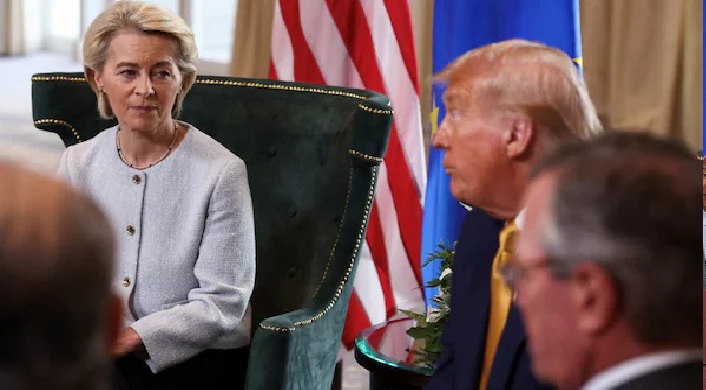
Announced after a high-stakes meeting between US President Donald Trump and European Commission President Ursula von der Leyen in Scotland, the deal slashes the previously threatened 30% tariff and offers both sides a political off-ramp.
Trump hailed the agreement as a breakthrough. “This is the biggest deal ever made,” he told reporters, claiming it would bring $600 billion in EU investment to the US and lead to large-scale purchases of American energy and defense equipment.
Von der Leyen acknowledged the deal was a compromise. “It’s the best we could get,” she said, calling Trump a “tough negotiator.” She said the 15% tariff would apply broadly but added that further talks would continue on sectors such as spirits and metals.
A Mixed Reaction in Europe
While the agreement avoids immediate economic pain, it received mixed reviews in Europe. German Chancellor Friedrich Merz welcomed the deal, saying it protected Germany’s crucial auto sector, which faced US tariffs as high as 27.5%.
However, Bernd Lange, chair of the European Parliament’s trade committee, criticized the outcome as unbalanced and warned the EU’s investment pledges could come at the cost of its own industries.
Though the 15% rate is lower than expected, it falls short of Europe’s goal of securing a tariff-free arrangement.
Deal Mirrors Japan Pact, Leaves Questions
The agreement closely resembles the US-Japan framework announced a week earlier and lacks key implementation details. Experts cautioned that such political agreements, while useful in the short term, can invite confusion and disputes later on.
Tariffs will apply to vehicles, semiconductors, and pharmaceuticals, among other categories. Exemptions include aircraft parts, agricultural products, raw materials, and some chemicals.
The US’s 50% tariff on steel and aluminum will remain for now, though a quota-based system is under discussion. Trump also retains authority to raise tariffs again if EU investment targets aren’t met, officials said.
Broader Trade Agenda
The deal marks another step in Trump’s ongoing effort to reshape US trade relations. He has reached similar preliminary agreements with Japan, the UK, Indonesia, and Vietnam, though critics argue that none have yet produced the structural reforms he seeks.
Trump continues to blame the EU for the US’s $235 billion goods trade deficit, despite the US’s services surplus with the bloc.
Earlier this month, the US threatened to impose a 30% tariff on EU goods starting August 1, prompting the EU to prepare countermeasures on $109 billion worth of American exports. That plan has now been shelved in light of the new agreement.
Despite questions over its long-term impact, both sides are selling the deal as a win—for stability, predictability, and diplomacy.
Comments are closed.