
Any Future Terror Attack Will Be Treated As An Act Of War: India Puts Pakistan On Notice

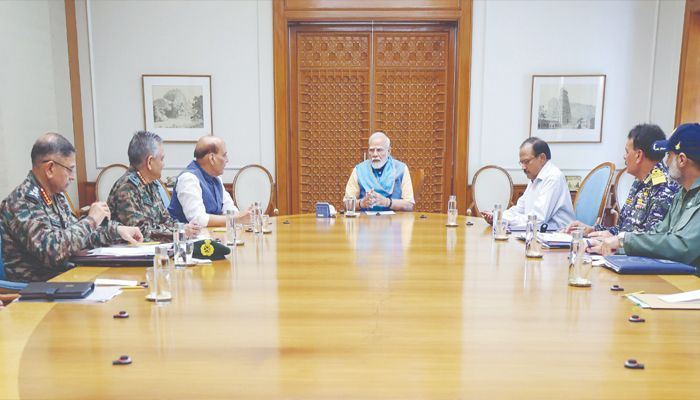
Amid soaring tensions following Operation Sindoor, India on Saturday issued a stern warning to Pakistan: any future terror attack on Indian soil will be considered an Act of War, sources said.
The warning is not an escalation, but a clear red line drawn in response to Pakistan’s repeated acts of aggression, including sustained drone and missile attacks targeting Indian military and civilian infrastructure.
An Act of War is defined as any armed assault or use of force that threatens a nation’s sovereignty, territorial integrity, or the safety of its people. The development implies that any future terrorist attack in India by Pakistan will be seen as waging a war, even as the Pakistani establishment—government or military—seeks de-escalation.
The hardline posture marks a significant shift in India’s counter-terror doctrine. New Delhi has made it clear that it will not hesitate to respond militarily to any attack, anywhere in India.
This huge messaging by the Narendra Modi government comes after sources told CNN-News18 earlier today that Pakistan is seeking de-escalation in tensions with India after being heavily pounded by the Indian Armed Forces in response to Islamabad’s brazen drone and missile strikes over three consecutive nights, starting May 7.
Sources revealed that Islamabad has conveyed interest in a Director General of Military Operations (DGMO)-level meeting with India to explore ways to lower tensions.
However, last night’s events tell a different story. Pakistan launched ‘Operation Bunyan-un-Marsoos,’ which was swiftly neutralised by the Indian military through coordinated strikes on major cities and multiple airbases across Pakistan.
Pakistan’s foreign minister, Ishaq Dar, on Saturday, however, said that his country would “consider stopping here” if India halted its military action. He also expressed hope for future dialogue, following calls for restraint from several international players.
Yet, Indian intelligence suggests that even as Pakistan speaks of peace, it continues to fuel unrest through proxy terror activity. Signals have reportedly been sent to terrorists operating in Kashmir to launch fresh attacks, possibly to divert the attention of Indian forces engaged along the northern and western borders.
“Desperate Pakistan is also goading for a fidayeen attack to distract security forces,” sources said.
The current crisis began when India launched Operation Sindoor in the early hours of May 7, avenging the April 22 Pahalgam terror attack in which 26 civilians were killed. In retaliation, the Pakistani military attempted to strike Indian cities and military bases using drones and missiles the same night. The Indian Army and Air Force responded with precision strikes deep inside Pakistan, targeting sites in Islamabad, Lahore, and Sialkot.
On May 9 night, Pakistan fired several armed drones and six ballistic missiles into the Indian territory. One of the Fatah-II missiles was reportedly aimed at New Delhi, but was shot down in Haryana’s Sirsa, saving hundreds of lives in the country.
In response, India hit Pakistan’s air force bases in Nur Khan Airbase in Rawalpindi, Rafiqi Airbase in Punjab’s Shorkot, and Murid Airbase in Punjab’s Chakwal, striking a huge blow to the Pakistani military.
The ruling BJP shared a video of Prime Minister Narendra Modi on X, while lauding India’s response to Pakistan.
“No room for fear, only action! Because now the time has come to grind the remaining ground of the terrorists into dust,” the party’s post on X said in a caption.