

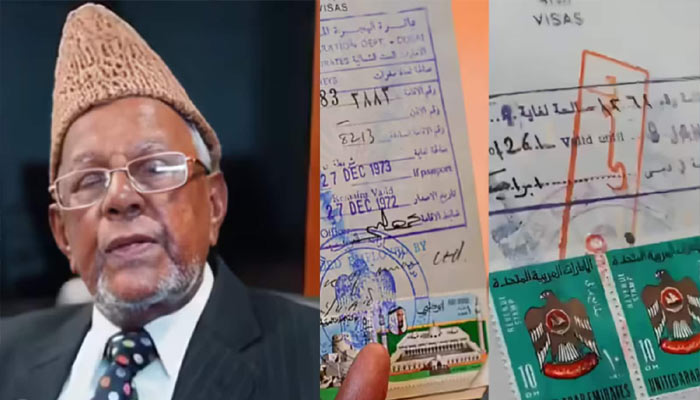
Six Decades Later, Indian Educator Who Arrived by Sea Receives Long-Awaited Recognition in UAE.
Nearly 60 years after he first set foot in Dubai—when the emirate had no ports or modern infrastructure—Indian educator Haji N Jamaluddin has finally received the recognition he richly deserves. Now 90, he was honoured in a special ceremony by Dubai Airports to commemorate his remarkable journey and legacy.
Jamaluddin left Mumbai for Dubai on February 26, 1965, arriving by sea. At that time, there were no formal immigration facilities, and he never received an official stamp in his passport. This week, history was corrected. In a symbolic tribute, Dubai authorities presented him with an immigration stamp retroactively dated to his arrival in 1965.
“We felt privileged to finally put a stamp in his passport to celebrate a legacy shaped by service, humility, and hope,” Dubai Airports shared on X (formerly Twitter). The post also quoted Jamaluddin’s enduring philosophy: “Education is the best weapon for enlightenment.”
A Lifelong Mission in Education
In 1984, Jamaluddin founded Crescent English High School in Dubai, aiming to make quality education accessible to families of all income levels. The institution now serves over 1,700 students and is considered one of the most affordable private schools in the UAE.
Reflecting on his journey, Jamaluddin said, “Money is not everything. Education is the best weapon for the enlightenment of the people. It gives you a stepping stone in life.”
A Son’s Tribute
The idea to honour Jamaluddin began with a heartfelt request from his son, Riyas Jamaluddin, who wrote to the CEO of Dubai Airports. He asked that his father’s pioneering contribution to the city be formally acknowledged with a commemorative stamp. The gesture was approved, and the family was invited to Dubai International Airport for the special ceremony.
From a sea voyage in 1965 to a legacy that continues to inspire, Haji N Jamaluddin’s journey is now a celebrated part of the UAE’s rich multicultural history.
Comments are closed.