

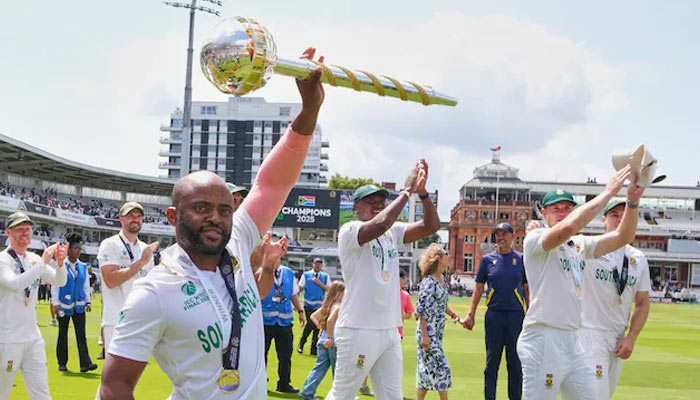
South Africa’s Triumph at Lord’s Marks a New Chapter in Test Cricket History
On a historic Sunday at Lord’s, South Africa lifted their first-ever World Test Championship title, defeating Australia in a dramatic final that went beyond sport—it echoed across history, identity, and redemption.
Chasing 282, the Proteas were led by a sublime century from Aiden Markram and a gritty 66 from skipper Temba Bavuma. The pair’s partnership turned the tide in a match where South Africa had earlier trailed by 74 runs, seemingly out of contention. But inspired spells from Kagiso Rabada and Lungi Ngidi brought them back, before Kyle Verreynne struck the winning runs and sparked nationwide jubilation.
A Captain Beyond the Scoreboard
Temba Bavuma, South Africa’s first Black African Test captain, stood still as his teammates erupted in celebration. From the Lord’s balcony, he let the moment settle in. This was more than just a victory. This was a release—from history’s burdens and from decades of near-misses. It was also a personal triumph for a player long forced to justify his place not just with runs, but against racial stereotypes.
“For us as a country, here’s an opportunity to—divided as we may be at times—forget all of that, rejoice in this moment, and just be one,” Bavuma said after the match.
For Bavuma, who was once nicknamed “Langa’s Sachin Tendulkar” in his township because of his short stature and love for the game, the journey has never been easy. From Langa to Lord’s, his path has carried the weight of history and expectations. In 2016, he became the first Black African batter to score a Test century for South Africa. That moment, he hoped, would silence the doubters. It didn’t.
“Even after the hundred, I don’t think it really dispelled the label of being a ‘quota player.’ That’s something players of colour often live with. But that’s also why I knew what this century meant—not just to me, but to the kids watching, especially the ones like me,” he once said.
A Legacy Forged Through Struggle
South African cricket has long carried the legacy of exclusion. Though the post-apartheid era saw racial quotas introduced, Black African cricketers remained rare in the top order. Most, like Bavuma, faced scrutiny not just over performance, but over belonging. The 2020–21 Social Justice and Nation-Building (SJN) hearings revealed just how deep-rooted the discrimination ran.
Bavuma rose above it—not just to play, but to lead.
Since 2021, he has averaged 49.77 in Tests, scoring 711 runs in South Africa’s most successful WTC cycle. As captain, he now boasts nine wins in 10 Tests—including a world title. And yet, his celebration was measured. Reserved. Reflective. Because the weight he carried wasn’t just personal—it was generational.
More Than a Trophy
South Africa’s win also represented something deeper for the nation—a symbolic unshackling from past heartbreaks. The ghosts of 1992, 1999, 2015… all put to rest at the home of cricket. For a country still reckoning with its past, this victory was a vision of what progress looks like—under the leadership of a man who embodies transformation.
The comparisons to Siya Kolisi, South Africa’s trailblazing Black rugby captain, are inevitable. But Bavuma’s story is distinct. Quieter. Less celebrated, perhaps—but no less powerful.
“I want to be seen as more than just a Black African cricketer,” Bavuma said. “I want to be remembered as someone who did something this country wanted. I’ll walk around with my chest out—and I hope it inspires others.”
This Cap Still Matters
In an age dominated by T20 leagues and commercial incentives, this victory was also a statement about the enduring power and prestige of Test cricket. About the value of tradition, of character, of resilience.
On Sunday, Bavuma and his team gave South Africa a reason to come together. Not just to cheer—but to believe. In cricket. In each other. In what’s possible when barriers are broken and opportunities are shared.
Comments are closed.