
Indian Students Back From Iran Recall Horror, Seek Clarity on Academic Future

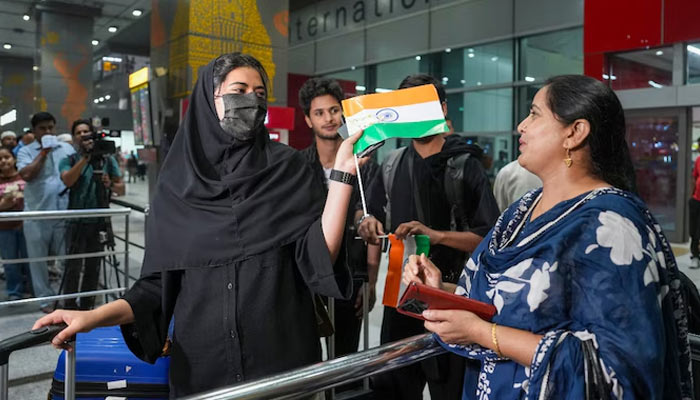
“We Saw Blasts, Dead Bodies”: Indian Students Return from Iran, But Future Unclear.
With the Indian flag clutched tightly in one hand and trauma written across her face, Mizban stepped out of Delhi’s Indira Gandhi International Airport on Saturday evening. “We saw dead bodies… heard blasts… saw airstrikes,” she murmured, eyes scanning the unfamiliar calm. “From Tehran to Qom to Mashhad, we were always on the move. I’m just grateful to be home. But if my university asks us to return, I’ll have to think hard.”
She was among 256 Indian students, most from Jammu and Kashmir, who arrived on a special charter flight from Iran—part of Operation Sindhu, India’s ongoing evacuation effort to bring back nationals stranded in the escalating conflict between Iran and Israel.
Just outside the terminal, Zubeda, a single mother from Srinagar, waited with a faded photo of her son, a medical student in Tehran. “I could hardly talk to him during the crisis,” she said. “He pretended to be brave for me. I want him to complete his studies—but not at the cost of living through war.”
Operation Sindhu: Racing Against Conflict
Saturday’s flight marked the third successful evacuation under Operation Sindhu, launched after hostilities erupted on June 13. So far, three chartered flights—two from Iran’s Mashhad and one from Turkmenistan’s Ashgabat—have brought back over 827 Indian nationals, including more than 300 students. A fourth flight was scheduled to land late Saturday night, expected to push the total past 1,000.
Junaid, whose younger brother and sister were studying in Iran, recalled the fear and confusion. “There were long gaps with no contact. My sister called from random numbers whenever she could. Their universities were near bombed areas. We didn’t sleep until we saw her in person.”
The evacuation came despite Iran’s closed airspace—an exception reportedly made for India amid the crisis. Students were first relocated from Tehran to Qom, then to Mashhad for evacuation.
India’s Deputy Chief of Mission in Tehran, Mohammad Javad Hosseini, confirmed Iran’s cooperation, calling it “a gesture of goodwill” during extraordinary circumstances.
The Road Ahead: Safe but Unsettled
Many of the returning students had chosen Iran for its affordable medical education. Now, they face deep uncertainty about whether and when they can return to resume their studies. Sumarah Rahman, a student from Kashmir, described nights filled with air raid sirens and explosions. “We were scared all the time. We prayed every night. Now that we’re home, we’re safe. But we don’t know what happens next.”
Final-year student Ahabashi added, “Tehran became unrecognizable overnight. If we had died there, it would’ve been so far from our families. But the evacuation was smooth. The Indian government managed every detail.”
The Jammu and Kashmir Students’ Association also issued a statement thanking the government for swift action and urging continued support for students still stuck in vulnerable regions. Back at the airport, Zubeda summed up what many parents were feeling: “I want my son to succeed, to become a doctor. But no degree is worth this fear.”
Comments are closed.