

US Releases Bunker Buster Test Footage to Defend Iran Strike Effectiveness.
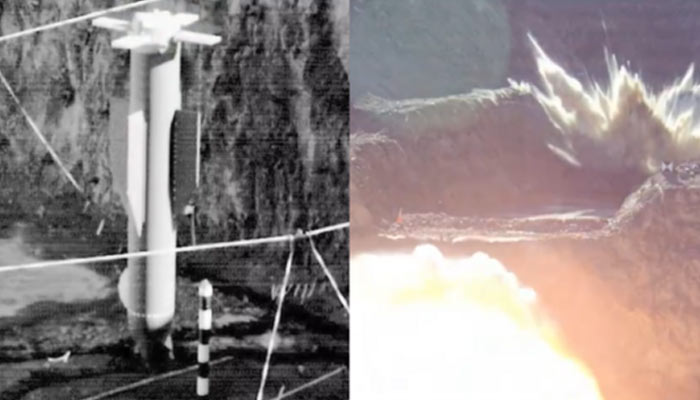
At a Pentagon press briefing on Thursday, U.S. Defense Secretary Pete Hegseth and General Dan Caine, Chairman of the Joint Chiefs of Staff, offered an in-depth explanation of the recent U.S. airstrikes on Iranian nuclear facilities. As questions continue to swirl over the impact of the attacks, officials shared previously unseen test footage of bunker buster bombs to underscore the operation’s success.
Responding to Intelligence Report Doubts
The press conference appeared to be a direct rebuttal to a classified Defense Intelligence Agency (DIA) report, which reportedly concluded that the strikes had damaged but not destroyed key facilities, setting back Iran’s nuclear program by only a few months.
Hegseth challenged the assessment, describing the strikes as “decimating — choose your word — obliterating, destroying.” He criticized the report as being based on “low confidence” intelligence with “gaps in the information.”
Inside the Bunker Buster Operation
Gen. Caine disclosed that 12 bunker buster bombs were deployed in the strikes, highlighting their unique capabilities. Unlike conventional munitions, bunker busters are designed to penetrate deep underground targets before detonating, meaning surface-level damage is minimal.
“A bomb has three damaging effects: blast, fragmentation, and overpressure. In this mission, overpressure and blast were the key kill mechanisms,” Caine explained.
Video clips showed simulated strikes, while Caine detailed the precision behind the real operation. At the Fordow facility, six bombs were used on each of two opposing ventilation shafts—targets that Iran had attempted to shield with concrete. The first bomb opened the shaft, followed by four bombs delivered at speeds over 1,000 feet per second. A sixth acted as a contingency “flex weapon.”
“The bombs hit exactly where intended,” Caine said, noting that no visible craters were expected due to the subterranean design of both the munitions and the targets.
Trump and Media Criticism
Hegseth also took aim at the media, accusing journalists of downplaying the mission’s significance and of being unwilling to credit former President Donald Trump for military accomplishments. “You miss historic moments,” Hegseth said, referencing record military recruitment levels.
President Trump echoed these sentiments on Truth Social, posting: “The cars and small trucks at the site were those of concrete workers trying to cover up the top of the shafts. Nothing was taken out of the facility — too long, too dangerous, and very heavy.”
Questions on Other Sites Remain
While officials extensively discussed the Fordow strike, they remained vague about operations at other locations. Natanz was reportedly targeted with two penetrator bombs, and Isfahan was struck by a missile launched from a Navy submarine. When asked about the 880 pounds of uranium believed to be stored at Isfahan, Hegseth responded: “We’re evaluating all intelligence and assessing what was where.”
Coordinated Military Effort
Gen. Caine concluded by commending the years-long planning and collaboration behind the mission. He acknowledged two officers from the Defense Threat Reduction Agency who spent 15 years studying Iran’s underground facilities, the engineers who designed the 30,000-pound bombs, the aircrews who executed the 37-hour mission, and U.S. troops who later defended against potential retaliation.
Comments are closed.