
Russia Unveils RS-28 Sarmat: A Missile Designed to Outfly and Outrange US, China

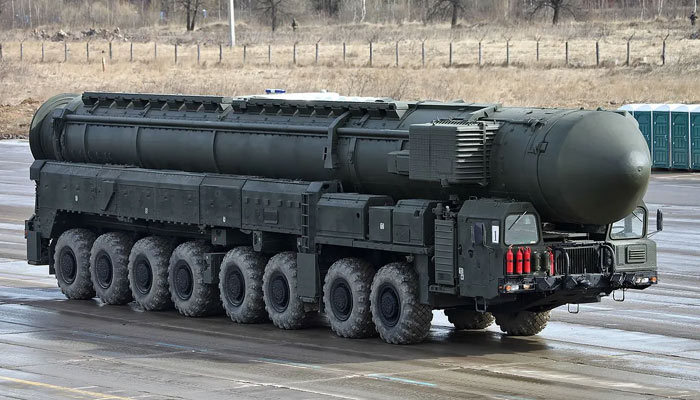
RS-28 Sarmat: Russia’s Hypersonic ‘Satan 2’ Missile Redraws Global Strike Map
With tensions rising between Moscow and Washington, Russia’s RS-28 Sarmat intercontinental ballistic missile—nicknamed “Satan 2” by NATO—is once again in global focus. Touted as the backbone of Russia’s nuclear deterrent, this next-gen ICBM is engineered to strike virtually any target on Earth, even via unconventional polar routes, all while outpacing American and Chinese missile systems.
A Weapon of Global Reach
Developed by the Makeyev Rocket Design Bureau, the Sarmat is a massive, liquid-fueled ICBM designed to replace the Cold War-era R-36M. It boasts a staggering range of up to 18,000 km, making it capable of hitting targets across both the North and South Poles—a feature meant to bypass Western missile defence networks.
With a launch weight of 208 tonnes and length of 35 meters, the missile can carry 10–15 nuclear warheads via a MIRV (Multiple Independently Targetable Reentry Vehicle) system. Some variants are believed to be equipped with Avangard hypersonic glide vehicles, designed to maneuver unpredictably during reentry, complicating interception.
Its estimated speed exceeds Mach 20, putting it squarely in the hypersonic category and far beyond the interception capability of traditional missile defence systems.
Strategic Message to the West
The renewed spotlight comes after the U.S. reportedly deployed two nuclear submarines close to Russian waters. Russia’s response has been to showcase its own strategic capabilities—chief among them, the RS-28 Sarmat. President Vladimir Putin has previously described the missile as “invincible” and capable of rendering NATO’s missile defences obsolete.
In performance metrics, the Sarmat clearly outpaces both the U.S. Minuteman III (range ~13,000 km) and China’s DF-41 (range ~12,000–15,000 km), not just in range, but also in payload and strike versatility.
Strengths and Vulnerabilities
Advantages:
- Global strike capability, including unconventional polar routes
- Multiple warheads and hypersonic payload options
- Unpredictable flight paths, challenging detection and interception
Drawbacks:
- Liquid-fueled engine requires longer prep time, reducing rapid response efficiency
- Reliability questions remain after a reported test explosion in 2024
- Space-based surveillance systems like the U.S. SBIRS may still detect early-stage launches
A New Era of Deterrence—or Escalation?
While Russia sees the RS-28 as a strategic equalizer, its deployment marks a worrying step in what many fear is a new nuclear arms race. The missile’s unmatched reach and payload signal not just power projection, but a shift in nuclear doctrine—one where speed, unpredictability, and over-the-pole targeting are the new norm.
Comments are closed.