
Historic Visit: Bangladesh and Pakistan Sign Key Trade, Diplomatic Agreements

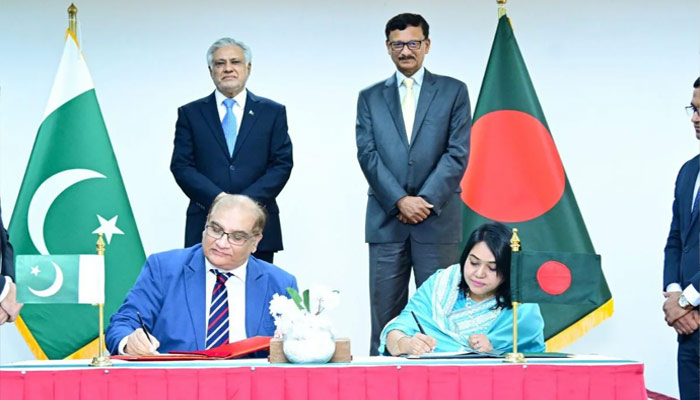
Bangladesh, Pakistan Sign Trade and Diplomatic Deals During Historic Visit.
Bangladesh and Pakistan signed a series of trade and diplomatic agreements on Sunday during Pakistani Deputy Prime Minister and Foreign Minister Ishaq Dar’s visit to Dhaka — the first such high-level engagement in over a decade.
Dar, the most senior Pakistani official to visit Bangladesh since 2012, arrived two days after Pakistani Commerce Minister Jam Kamal Khan. Pakistan called the visit “historic” and a “significant milestone” in bilateral relations, which have improved following the ouster of former Bangladeshi leader Sheikh Hasina.
During his meetings with Bangladesh’s interim administration, Dar and Foreign Affairs Adviser Touhid Hossain signed agreements to:
- Exempt visas for officials and diplomats
- Establish a joint trade working group
- Promote cooperation between foreign service academies and national news agencies
Develop an institutional partnership between Bangladesh Institute of International and Strategic Studies and the Institute of Strategic Studies Islamabad Hossain also confirmed plans for direct flights between the two countries, with two Pakistani airlines receiving initial approval.
“Pakistan is an important neighbor with whom we share historical ties. We are determined to advance our relationship,” Hossain said.
The talks focused on boosting trade and investment and aligning on bilateral and multilateral issues. Relations had been limited for years due to Bangladesh’s 1971 war crimes trials and Hasina’s pro-India stance, but exchanges with Islamabad have picked up since her removal.
Regional cooperation through the South Asian Association for Regional Cooperation (SAARC) was also discussed. Hossain said, “This cooperation will increase further,” highlighting youth linkages, connectivity, and economic collaboration.
Dar also met Nobel laureate and interim government head Prof. Muhammad Yunus to discuss reviving ties and expanding economic and youth cooperation. Experts note that while the agreements signal Pakistan’s eagerness to improve ties, the long-term impact depends on Bangladesh’s next elected government, with general elections expected in February 2026.
“Interim governments are short-lived, and it is up to the next political administration to determine the depth of these ties,” said Shomsher Mobin Chowdhury, former Bangladesh foreign secretary.
Comments are closed.