
Swiss Glaciers Shrink by 25% in Just 10 Years Amid Record Melting
Switzerland is home to nearly 1,400 glaciers, the most of any country in Europe, and the ice mass and its gradual melting have implications for hydropower, tourism, farming and water resources in many European countries.

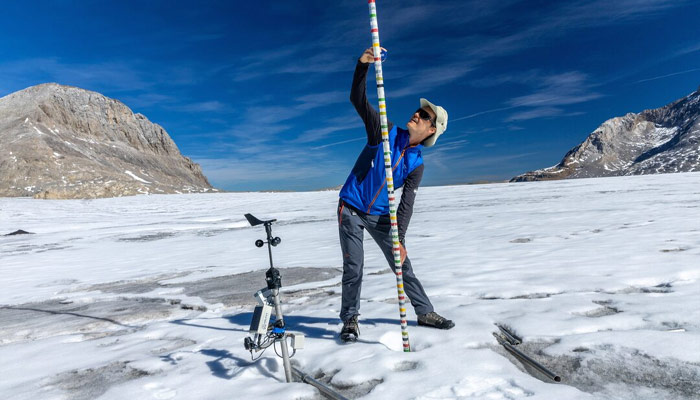
Switzerland’s glaciers are continuing to melt at alarming rates, with ice volume shrinking by 3% in 2025 alone — the fourth-largest annual loss ever recorded, Swiss glaciologists reported on Wednesday.
According to the Swiss glacier monitoring group GLAMOS and the Swiss Academy of Sciences, this year’s decline has pushed the country’s overall glacier volume down by one-quarter over the past decade. Switzerland is home to nearly 1,400 glaciers — more than any other nation in Europe — but more than 1,000 smaller glaciers have already disappeared.
“Glacial melting in Switzerland was once again enormous in 2025,” the scientists said in their annual report. They attributed the losses to a combination of unusually low winter snowfall and intense summer heat waves in June and August, which stripped away snow reserves by early July and triggered unusually early melting.
Matthias Huss, head of GLAMOS and a glaciologist at ETH Zurich, stressed that human-driven climate change is the decisive factor. “Glaciers are clearly retreating because of anthropogenic global warming. This is the main cause of the acceleration we’ve seen in the last two years,” he said.
The 2025 melt follows record-breaking losses in 2022 and 2023, and a similar severe decline in 2003. Scientists warn that the retreat is reshaping Switzerland’s landscapes, destabilising mountain slopes and increasing the risk of rockfalls and landslides.
The threat became evident earlier this year when a massive chunk of rock and ice broke away from a glacier and buried much of the southern village of Blatten in May. Authorities remain on high alert for further collapses.
Beyond the immediate dangers, the rapid melting of Swiss glaciers poses long-term challenges for Europe’s hydropower, farming, tourism, and freshwater supplies.
Comments are closed.