

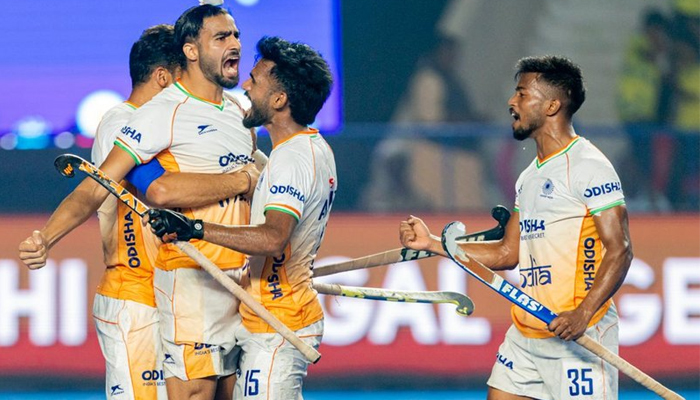
Sometimes teams chase shadows, and for most of the first three quarters, that’s exactly what India did.
Their play looked conflicted—stylish in brief flashes but largely uneven, the defining traits of this junior side refusing to merge. But when everything finally clicked in the fourth quarter, India didn’t just equalise—they stormed past Argentina to claim what may be one of the most important bronze medals in Indian junior hockey history.
The 4–2 win over the two-time world champions (2005, 2021) signals not just progress but depth. It suggests a bench strong enough to make the juniors-to-seniors transition smoother in the years ahead.
Argentina will rue this one. Protecting a 2–0 lead with a quarter left, they chose to sit back. Their earlier fluent runs through the middle disappeared, and India’s aggressive press in the third and fourth quarters shook them. Doubts crept in: step forward and leave space, and India would punish them. That is exactly what unfolded. From 0–2 down, India delivered a furious 15-minute turnaround—built partly on clever indirect penalty-corner variations that Indian teams, even senior ones, rarely deploy under pressure.
In tight contests, especially at 2–2, trying a central deflection requires nerve. India did it twice—first to reduce the deficit, then to level, before overpowering Argentina 3–2 and finally sealing the win 4–2 when Anmol Ekka converted a seventh PC with Argentina’s goalkeeper withdrawn.
Ekka, fittingly, became the central figure. Three minutes in, he crashed into Nicolás Rodríguez inside the circle, conceding a penalty stroke. It was the kind of costly early error that can derail young players. But Ekka recovered, reasserted himself, and by halftime was pushing up, pressing harder, and making assertive runs.
India’s early problems lay in transition. They didn’t isolate defenders, didn’t create space, and rarely made off-the-ball runs. Much like their semifinal against Germany, they crowded the field, making clearances simple for Argentina. Cohesion was missing.
Argentina weren’t overly threatening, but they hovered, waiting for loose balls, deflections, and mistakes. With India misfiring their first four PCs, the South Americans struck in the 44th minute: Federico Hanselmann flicked across goal, Santiago Fernandez spun and slammed it home. At 2–0, India’s path narrowed. One quarter remained to change everything.
The risk calculus shifts in the fourth quarter of a medal match. Down by two, with a generation of players staring at fourth place, subtle tactical changes can redefine legacies. India, dormant for three quarters, suddenly ignited. Argentina, visibly rattled, saw their coaches warned for constant protests.
In the 49th minute, Arshdeep was shoved—PC No. 5. Ekka flicked, Ankit Pal deflected. 1–2. The stadium roared back to life. Minutes later, Arshdeep charged down the right, was impeded again—PC No. 6. Another Ekka flick, another central deflection, this time from Manmeet. 2–2. Argentina were wobbling.
Momentum had fully shifted. Arshdeep, now dominant, held the ball with composure and forced another foul inside the circle. Captain Tomás Ruiz pushed him—stroke awarded. Sharda Nand Tiwari converted, and India led 3–2 with three minutes left.
Argentina, fatigued and flustered, threw their last punches, earning a fifth PC. India defended with discipline. With seconds ticking away, Argentina pulled their goalkeeper, but desperation bred poor tackles. Ruiz fouled again, and India won their seventh PC. Ekka stepped up and smashed home the insurance goal. 4–2. Bronze secured.
Ekka’s redemption, Arshdeep’s transformation and the team’s collective surge shaped a final quarter that will be remembered for years. More than a medal, this win offered a glimpse of what this group might become.
There is a unique joy in watching a team build itself. India did that in 15 unflinching minutes.
Comments are closed.