
Toxic smog and dense fog engulf Delhi-NCR as AQI worsens to ‘severe’

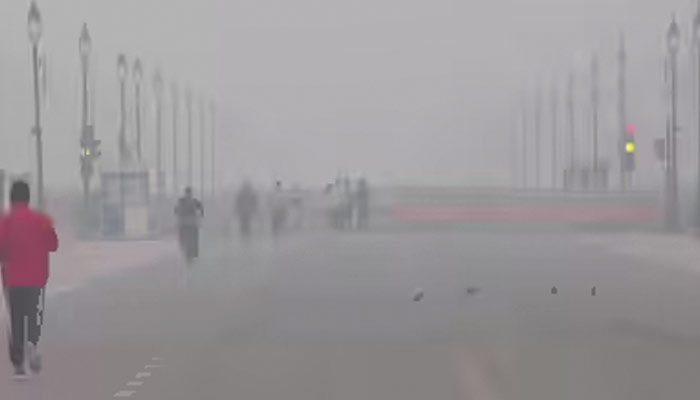
Air pollution in Delhi and the surrounding National Capital Region (NCR) worsened further on Sunday, a day after air quality slipped into the ‘severe’ category.
As a thick blanket of toxic smog and dense fog engulfed the city, pushing AQI levels close to the maximum measurable limit and sharply reducing visibility. According to data from the Central Pollution Control Board (CPCB), Delhi’s average Air Quality Index (AQI) rose to 461 at 7 am, up from 431 on Saturday.
All monitoring stations in ‘severe’ category
All 40 air quality monitoring stations across the capital recorded ‘severe’ readings. Rohini reported the highest AQI at 499, followed by Bawana (498), Vivek Vihar (495), Ashok Vihar and Wazirpur (493 each), Narela (492) and Anand Vihar (491).
Several other areas also saw extremely poor air quality, including Mundaka (486), ITO (485), Punjabi Bagh (478), Nehru Nagar (476), and Chandni Chowk and Okhla (470 each). Even relatively greener locations such as Lodhi Road (400) and Najafgarh (404) failed to escape the pollution grip.
NCR cities record alarming pollution levels
The pollution crisis extended beyond Delhi, with Noida recording an AQI of 470 and Ghaziabad 460, both in the ‘severe’ category. Gurugram’s air quality remained ‘very poor’ at 348, while Faridabad registered an AQI of 220, classified as ‘poor’.
Dense fog disrupts visibility, airport operations
From early morning, dense smog mixed with fog reduced visibility across large parts of Delhi, with some areas reporting near-zero visibility. Low-visibility procedures were activated at Indira Gandhi International Airport, though flight operations continued under precautionary protocols.
The India Meteorological Department (IMD) said visibility at the airport could drop to around 100 metres during early morning hours, improving to about 800 metres later in the day. The department warned that moderate to dense fog would persist across Delhi over the next few days.
Weak winds worsen pollution
IMD attributed the deteriorating conditions to weak winds caused by a western disturbance over north Pakistan and the presence of a strong subtropical westerly jet stream over northwest India. Calm wind conditions, shifting wind directions and increased moisture trapped pollutants near the surface, creating ideal conditions for smog formation.
GRAP Stage-IV enforced across NCR
Amid the worsening trend, the Sub-Committee of the Commission for Air Quality Management (CAQM) invoked Stage-IV of the Graded Response Action Plan (GRAP) — classified as ‘Severe+’ — across the entire NCR on Saturday night.
The decision followed a steady rise in AQI levels through the evening, with Delhi’s AQI climbing from 431 at 4 pm to 441 by 6 pm.
Emergency measures rolled out
Under Stage-IV, entry of BS-IV diesel trucks into Delhi has been banned, except for vehicles carrying essential commodities. Delhi-registered BS-IV and older diesel heavy goods vehicles have also been prohibited, barring essential services.
All construction and demolition activities have been halted, including public infrastructure projects, while stone crushers, mining operations and related activities across NCR have been ordered to shut down.
Schools shift to hybrid mode
State governments in NCR and the Delhi government have been directed to conduct classes for students of Classes VI to IX and XI in a hybrid mode. Authorities may extend the option to other classes if conditions worsen.
Health advisory issued
CAQM urged residents to follow GRAP’s Citizen Charter, advising children, the elderly and those with respiratory or cardiac conditions to avoid outdoor activities. Use of masks and minimising exposure have been strongly recommended.
Brief improvement earlier proves short-lived
Delhi’s air quality had briefly improved earlier in the week, dipping to 282 on Tuesday and 259 on Wednesday. However, pollution levels began rising again from Thursday, crossing into the ‘severe’ category on Saturday and worsening further on Sunday.
Health impact
As per CPCB norms, AQI levels above 401 are categorised as ‘severe’, posing health risks even to healthy individuals. Prolonged exposure can cause respiratory distress, eye irritation, reduced lung function and cardiovascular complications.
Authorities warned that with adverse weather conditions persisting, hazardous air quality may continue in the coming days, further impacting public health and daily life in the capital.
Comments are closed.