

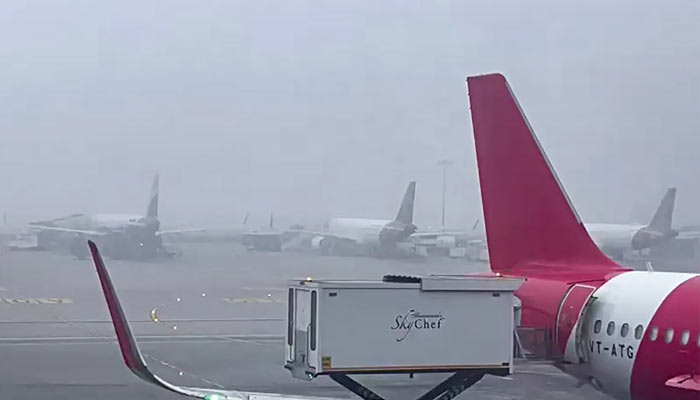
A toxic combination of dense fog and hazardous air pollution continued to blanket the national capital on Friday, disrupting air and rail services and pushing air quality closer to the “severe” category.
with conditions expected to deteriorate further over the weekend. More than 700 flights were affected through the day as visibility plunged across the city, while at least 177 flights and 50 trains were cancelled. Of the cancelled flights, 88 were departures and 89 arrivals, including two international services, airport authorities said.
The India Meteorological Department (IMD) issued an orange alert for fog for Saturday, warning of dense to very dense fog during early morning hours. The Air Quality Early Warning System forecast the Air Quality Index (AQI) to breach the 400 mark, placing Delhi in the “severe” category over the weekend.
“Dense to very dense fog is expected at several places during the early hours of Saturday. Shallow fog or mist may also occur during night hours,” an IMD official said. Moderate fog is likely on Sunday and Monday, with dense fog in isolated pockets during the morning.
On Friday, visibility dropped to zero at Safdarjung at around 5.30 am and fell to 50 metres at Palam, prompting the IMD to issue a red alert in the early hours. Delhi’s 24-hour average AQI stood at 374, firmly in the “very poor” category, while morning readings rose to 382, edging closer to the severe threshold of 401. Eleven of the city’s 40 air quality monitoring stations recorded “severe” levels during the day.
Vivek Vihar recorded the worst air quality with an AQI of 434, followed by Anand Vihar at 430. At one point, 14 stations slipped into the severe category before marginal improvement was seen later.
Friday marked the ninth consecutive day of very poor or severe air quality in Delhi, despite intensified vehicular enforcement launched a day earlier. Thousands of challans were issued across the NCR, disrupting private transport and reinforcing the Supreme Court’s recent observation of a “total failure” of reactive pollution control measures.
The minimum temperature on Friday was recorded at 9°C, nearly one degree above normal, while the maximum reached 22.2°C. Forecasts indicate minimum temperatures could drop to 7–9°C on Saturday, with daytime highs between 21–23°C over the weekend, before cooling further next week.
Meteorologists warned that falling temperatures could intensify inversion conditions, trapping pollutants near the surface.
“A drop in temperature strengthens inversion conditions, preventing pollutants from dispersing,” said Anumita Roychowdhury, executive director at the Centre for Science and Environment, adding that pollution spikes would depend on wind speed and other meteorological factors.
Data from the Centre’s Decision Support System showed vehicular emissions accounted for 15.72% of Friday’s pollution load. This contribution is expected to rise to 17.36% on Saturday and 18.41% on Sunday, despite restrictions on older vehicles and those lacking valid pollution certificates.
December has already seen three severe air quality days between December 13 and 15, making it the dirtiest December in eight years so far. In November, Delhi endured 24 consecutive days of very poor air, including three severe days.
Earlier this week, the Supreme Court directed the Commission for Air Quality Management to move away from short-term emergency responses and focus on structural reforms, including urban mobility, industrial emissions and stubble burning, calling for coordinated action across Delhi, Uttar Pradesh, Haryana and Rajasthan. The matter will be heard again on January 6.
The situation has been aggravated by the absence of rainfall this month, with Safdarjung recording zero precipitation in December, limiting the natural dispersal of pollutants.
Meanwhile, Delhi Airport issued a passenger advisory stating that low-visibility procedures remain in place. “All flight operations are functioning normally. Passengers are advised to contact their respective airlines for the latest updates,” the advisory said.
Comments are closed.