

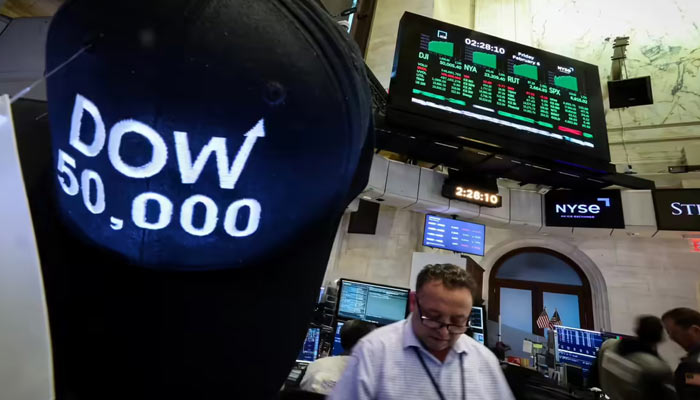
The Dow Jones Industrial Average has crossed the psychological 50,000-point mark for the first time, a milestone that has rippled through global markets and renewed debate over.
The durability of the US economic rebound. The rally has been driven by strong corporate earnings—particularly in technology and energy—along with sustained investor confidence as inflation cools and interest rates stabilise. Together, these factors point to a long-sought “soft landing”, where growth remains intact without reigniting price pressures.
For global investors, the 50,000 level is more than a headline number. It signals confidence in the earnings power and balance-sheet strength of America’s largest corporations, many of which shape global capital flows, supply chains and investment sentiment far beyond US borders.
The ‘wealth effect’ and India
For India, the implications are layered rather than linear. A buoyant US equity market tends to generate a wealth effect, lifting consumption and corporate spending. That matters for India, one of America’s key partners in pharmaceuticals, IT services, engineering goods and textiles. As US demand expands, Indian exporters are often among the early beneficiaries.
Recent trade agreements between New Delhi and Washington further amplify this effect. Reduced barriers and clearer regulatory pathways have made it easier for Indian technology and engineering firms to plug into US supply chains, including those of companies represented on the Dow. Historically, a strong Wall Street has also encouraged higher capital flows into emerging markets, with India remaining a preferred destination for foreign institutional investors seeking long-term growth.
Trade, strategy and ‘China Plus One’
The Dow’s record run also coincides with a broader strategic shift underway in global manufacturing. The so-called “China Plus One” approach—now reinforced by trade and technology cooperation—has pushed US companies to diversify production bases. A confident US market provides the capital and risk appetite needed for such relocation, and India has positioned itself as a key alternative.
Collaborations in critical and emerging technologies have become central to this relationship. The valuations of US tech majors are increasingly intertwined with their overseas partnerships, including research, design and manufacturing ecosystems in cities such as Bengaluru and Hyderabad. In that sense, optimism on Wall Street often feeds into sentiment on Dalal Street, assuming domestic macroeconomic stability holds.
Risks to watch
The milestone, however, is not without caveats. Some analysts warn of a growing disconnect between record equity valuations and cost-of-living pressures faced by ordinary Americans. For India, the principal risk lies in a sudden shift in US monetary policy. Any move by the Federal Reserve to tighten liquidity sharply could trigger a “taper tantrum”, reversing capital flows from emerging markets.
There is also the longer-term risk of protectionist sentiment resurfacing after periods of market exuberance. While recent trade agreements offer India a measure of insulation, policymakers and investors alike will need to remain alert.
For now, the Dow’s climb to 50,000 stands as a powerful symbol of confidence. For India, the opportunity lies in converting that confidence into sustained trade, investment and strategic gains—without losing sight of the risks that accompany every historic rally.
Comments are closed.