

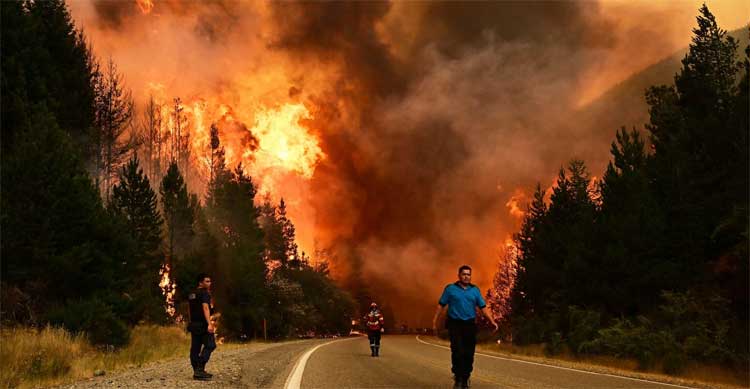
Drier-than-normal conditions that helped trigger devastating wildfires in Chile and Argentina earlier this year were significantly influenced by human-driven climate change, according to a new analysis by the World Weather Attribution (WWA) consortium.
The study found that global warming made the extreme fire weather between 2.5 and three times more likely, raising serious concerns for fragile ecosystems, including forests home to some of the world’s oldest trees.
WWA, an international collaboration of climate scientists, conducts attribution studies to assess how climate change affects the probability and intensity of extreme weather events.
Researchers concluded that the affected regions are now receiving substantially less rainfall than they would in a world without fossil fuel emissions. “We estimate that these areas are experiencing roughly 20–25 per cent less rainfall than in a climate unaffected by greenhouse gas warming,” the study said. Weak La Niña conditions also contributed to the unusual dryness.
Fires Sweep Across Patagonia and Central Chile
In early January 2026, wildfires erupted in Argentina’s Chubut province in Patagonia, spreading into Los Alerces National Park, a UNESCO-listed site known for its ancient Alerce trees, some of which are more than 3,000 years old.
Days later, between January 17 and 19, fresh fires ignited in Chile’s Biobío and Ñuble regions. The blazes destroyed around 1,000 homes, forced approximately 52,000 people to evacuate, and claimed 23 lives. By January 23, fires had scorched nearly 64,000 hectares, prompting authorities to declare a state of emergency.
Heat, Wind and Prolonged Drought
Scientists said the fires were driven by a dangerous mix of high temperatures, strong winds, and long-term drought.
Maximum temperatures exceeded 37°C, while wind speeds surpassed 40 km/h, conditions that rapidly intensified fire spread. Central-southern Chile has been grappling with a prolonged drought for more than a decade, with some estimates tracing its onset to 2007.
In Argentina, fire activity surged again in late January, affecting forested valleys and lake districts near Cholila, Puerto Patriada, El Hoyo, El Bolsón, Lago Puelo, and Los Alerces National Park. Authorities declared another state of emergency on January 29 after an additional 45,000 hectares burned.
As of mid-February, several areas were still battling active fires. WWA noted that new major fire events continued to threaten ancient forest zones.
Measuring Climate Change’s Role
To analyse the drivers of the fire weather, researchers used the Hot-Dry-Windy Index (HDWI), which combines temperature, humidity, and wind data to evaluate wildfire risk.
While HDWI does not account for fuel accumulation, scientists said it is a reliable indicator of fire danger and suppression difficulty.
The analysis showed that such extreme fire conditions are now roughly once-in-five-year events. Climate models indicated these events would have been far less likely without human-induced warming.
According to the study, climate change made the Chilean fire conditions about three times more likely and the Patagonia conditions approximately 2.5 times more likely.
Drying Trends and Climate Patterns
The study also identified a significant decline in rainfall. Fire-season precipitation has dropped by about 25 per cent in parts of Chile and 20 per cent in Patagonia, researchers said.
Higher temperatures have further worsened conditions by increasing evapotranspiration, drying out vegetation and making landscapes more combustible.
Natural climate variability also played a role. La Niña patterns typically shift rainfall away from the region, while the Southern Annular Mode (SAM) helped reinforce persistent hot and dry conditions by influencing atmospheric pressure systems and wind patterns.
Vegetation Amplified Fire Risk
Researchers also highlighted the role of land use and vegetation. Non-native needleleaf species, particularly monoculture pine plantations (Pinus radiata), contributed to heightened fire risk.
“These plantations are highly flammable due to dense, uniform fuel structures,” the report noted, stressing that early removal of invasive pines is critical to reducing large-scale fire hazards.
Juan Antonio Rivera, a WWA author from Argentina’s Institute of Nivology, Glaciology and Environmental Sciences (IANIGLA), warned that the fires are threatening both communities and irreplaceable natural heritage.
“In Patagonia, blazes are endangering ancient Alerce trees — living giants that have survived for thousands of years,” Rivera said.
“For Chile and Argentina, the drying of our landscapes is no longer a future projection but an unfolding crisis requiring urgent action.”
Comments are closed.