

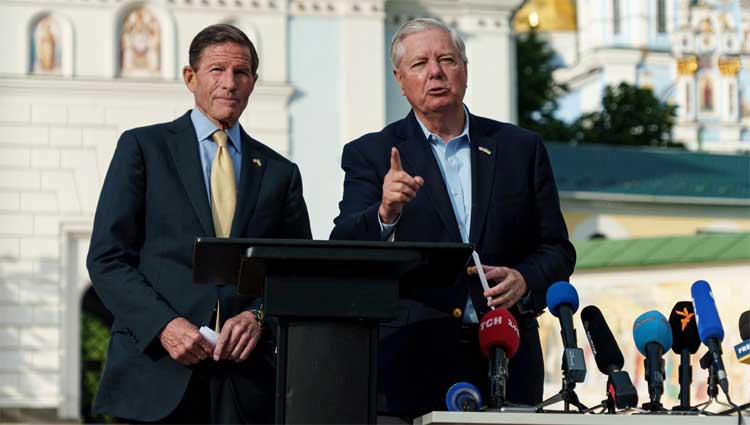
A bipartisan group of US senators returned Wednesday from a visit to Ukraine, aiming to revive momentum in Congress for a new wave of sanctions designed to squeeze Moscow’s economy and push President Vladimir Putin toward concessions in peace negotiations.
The trip marked the first visit by US senators to Odesa — Ukraine’s third-largest city and a strategically vital Black Sea port heavily targeted by Russian attacks — since the war began nearly four years ago. Democratic Sens. Jeanne Shaheen, Chris Coons, Richard Blumenthal and Sheldon Whitehouse took part. Republican Sen. Thom Tillis had been expected to join but withdrew for personal reasons.
“Everywhere we went, we heard the same message: Ukrainians want peace, but not at the cost of their sovereignty or territorial integrity,” Shaheen told reporters during a call.
The visit comes at a sensitive juncture in the conflict, with Russian and Ukrainian delegations meeting in Switzerland for US-brokered talks. Despite the diplomatic push, neither side has shown flexibility on core disputes such as territory and security guarantees. The senators argued that tougher sanctions could alter the Kremlin’s calculus, particularly as Washington has set a June deadline for progress.
“Virtually no one believes Russia is negotiating in good faith,” Whitehouse said. “That makes sustained pressure essential.”
Sanctions legislation, however, has remained stalled on Capitol Hill for months. Lawmakers have floated multiple proposals, including a sweeping Senate bill that would authorize tariffs and secondary sanctions on countries purchasing Russian oil, gas, uranium and other key exports — revenues seen as critical to financing Russia’s military operations.
Other measures advanced by the Senate Foreign Relations Committee target China’s alleged support for Russia’s defense sector, seek to repurpose frozen Russian assets, and crack down on Moscow’s so-called “shadow fleet” of tankers used to evade existing restrictions.
Sen. Lindsey Graham, a Republican co-sponsor of the broader sanctions package, said over the weekend that Senate Majority Leader John Thune would bring the bill forward once it secures the 60 votes needed for passage. “This legislation will be a game changer,” Graham said. “President Trump supports it. It’s time for a vote.”
Blumenthal, who co-authored the bill with Graham, described the proposal as a “sledgehammer of sanctions and tariffs,” while acknowledging that outstanding details remain. Some Democrats — and a few Republicans — have voiced concerns over the tariff provisions, citing opposition to Trump’s wider tariff strategy.
In the House of Representatives, resistance to the tariff elements has prompted alternative proposals. A bipartisan initiative led by Republican Rep. Brian Fitzpatrick would tighten limits on presidential authority to waive sanctions while dropping the tariff components. Separately, legislation introduced by Rep. Gregory Meeks, the top Democrat on the House Foreign Affairs Committee, would allocate an additional $8 billion in military assistance to Ukraine. Democrats are currently seeking one more Republican backer to force a vote.
Following their return, the senators said they plan to highlight the impact of Russian strikes on US-linked businesses operating in Ukraine and to intensify calls for expanded military aid. “Putin responds to strength, not rhetoric,” Blumenthal said.
Despite uncertainty surrounding the Trump administration’s long-term posture on Ukraine and European security, the lawmakers said discussions with allies at the Munich Security Conference underscored continued transatlantic resolve.
“We spoke with one voice — Democrats and Republicans alike — about sustaining support for Ukraine,” Coons said.
Comments are closed.