
Why Mars Lost Its Oceans: Scientists Identify the Crucial Missing Link

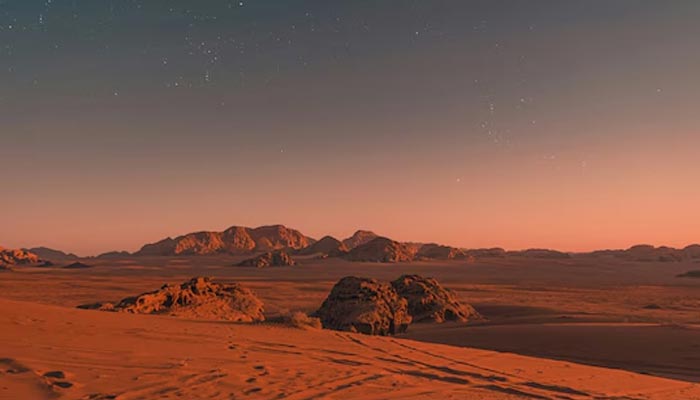
Scientists may be closer to answering one of planetary science’s biggest mysteries — how Mars lost the vast amounts of water that once flowed across its surface.
Today, Mars is a cold, arid world. But dried-up river channels, ancient lakebeds and mineral traces show that liquid water was once abundant. For years, researchers have tried to piece together how the Red Planet shifted from a potentially habitable environment to the barren desert it is now.
A new international study published in Communications Earth & Environment points to an overlooked culprit: regional dust storms.
The research team — including scientists from the Instituto de Astrofísica de Andalucía, the University of Tokyo, and Tohoku University — examined atmospheric data from the Northern Hemisphere summer of 2022–23. During that time, a powerful but localized dust storm injected unusually high levels of water vapor into the planet’s middle atmosphere.
Previously, scientists believed this season had only a minor role in water escape. Most studies focused on global dust storms or the warmer Southern Hemisphere summer, when sunlight is stronger and atmospheric activity more intense.
But this event told a different story.
Water vapor levels in the middle atmosphere surged to nearly ten times their normal concentration. Shortly afterward, hydrogen levels near the edge of space climbed to about 2.5 times typical amounts. That matters because when ultraviolet radiation breaks apart water molecules, hydrogen — being extremely light — can escape Mars’ weak gravity and drift into space. Once that hydrogen is gone, the water it came from is lost permanently.
The findings suggest that even short-lived, regional dust storms can significantly accelerate this escape process. Over millions or billions of years, repeated events like this may have steadily stripped Mars of its oceans. By highlighting the impact of regional storms — not just massive planet-wide events — the study adds a critical new piece to the puzzle of how Mars became the dry world we see today.
Comments are closed.