

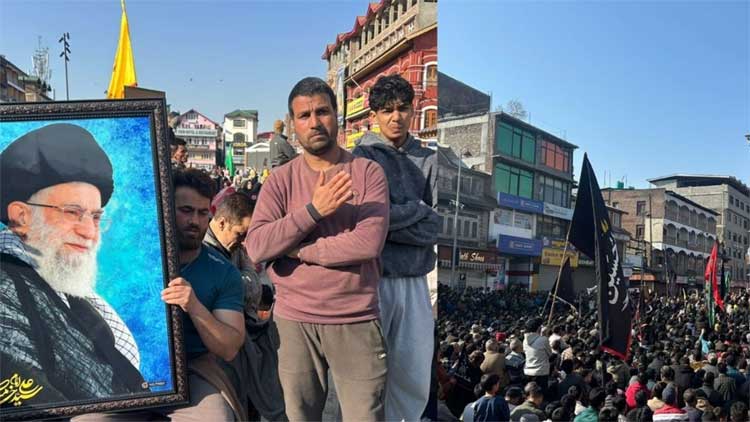
Protests erupted in parts of Jammu and Kashmir after Iran confirmed the death of Supreme Leader Ali Khamenei. Iranian state media reported that the 86-year-old cleric died in the early hours of Saturday during joint military strikes carried out by Israel and the United States.
Demonstrations were reported from Srinagar, Sonawari and Bandipora, where protesters raised slogans and voiced anger over the reported attack. Hundreds of Kashmiri Shia Muslims took to the streets carrying portraits of Khamenei and banners expressing support for Iran.
In Srinagar, black flags, images of the Ayatollah and traditional mourning chants (Nauha) marked the protests. One demonstrator told ANI that the community was deeply saddened by the news, describing Khamenei not just as a political leader but as a Marja-e-Taqlid — a religious source of emulation — for many Shia Muslims.
Iranian state media said Khamenei, who had led the Islamic Republic for more than three decades and steered it through confrontations with Israel and the United States, was killed in the strikes.
Mehbooba Mufti criticises US-Israel action
Mehbooba Mufti, president of the Jammu and Kashmir Peoples Democratic Party (PDP), strongly criticised Israel and the United States following reports of Khamenei’s killing. In a statement, she described the development as a “deeply tragic and shameful point in history,” accusing the two countries of boasting about the death of Iran’s leader.
Mufti also expressed disappointment over what she termed the silence or implicit support of several Muslim-majority nations, saying history would judge those who stood for justice and those who sided with oppressors.
From Khomeini’s successor to Iran’s longest-serving ruler
Khamenei assumed power in 1989 after the death of Ruhollah Khomeini, the architect of the 1979 Islamic Revolution that toppled Shah Mohammad Reza Pahlavi and established clerical rule in Iran. Initially viewed as a relatively low-profile cleric, Khamenei went on to become the Islamic Republic’s longest-serving supreme leader.
Over 35 years, he consolidated theocratic authority, expanded the influence of the clerical establishment and strengthened the role of the Islamic Revolutionary Guard Corps (IRGC), which grew into Iran’s most powerful military and economic force. Through a network of appointed bodies with the power to overrule elected institutions, Khamenei became the ultimate decision-maker in Iran’s political system, with hardliners often describing his authority as second only to God.
Comments are closed.