
Schools closing across Gulf show children bear brunt of wars, UN chief tells Security Council

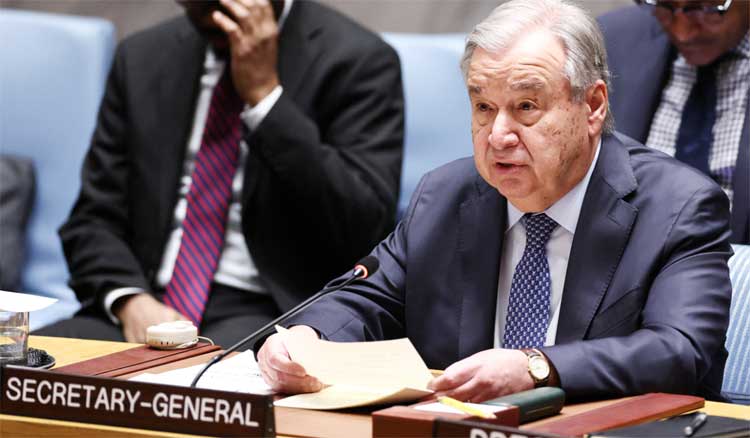
Closed schools across the Gulf this week are a stark reminder that when conflicts escalate, children are often the first to suffer — losing their classrooms, their sense of safety and, too often, their lives — the United Nations secretary-general told the Security Council on Monday as the war with Iran entered its third day.
As clashes between Iranian and US-Israeli forces intensified, disrupting daily life and raising security fears, authorities in the United Arab Emirates, Qatar, Bahrain and Oman ordered schools to close and switch to remote learning. The precaution underscored how geopolitical tensions are reverberating across the wider region.
Over the weekend, reports from southern Iran alleged that an elementary school in the town of Minab had been struck, killing dozens of children. US officials said they were reviewing the claims.
Addressing the Security Council on behalf of Secretary-General Antonio Guterres, UN Under-Secretary-General Rosemary A. DiCarlo warned that the world is witnessing the highest number of armed conflicts since the Second World War — along with the highest civilian death tolls in decades. The meeting was presided over by US First Lady Melania Trump, as the United States holds the rotating presidency of the 15-member council this month.
“When conflicts erupt, children are among those most severely affected,” DiCarlo said, noting that one in five children worldwide — about 473 million — live in or are fleeing conflict zones, according to UNICEF.
Verified grave violations against children rose 25 percent between 2023 and 2024, she said, while cases of rape and other forms of sexual violence increased by 35 percent, citing the secretary-general’s annual report on children and armed conflict.
“These horrific figures should impel us to do more to protect children in conflict,” DiCarlo added, also acknowledging Melania Trump’s efforts to spotlight the plight of children in war, including work to reunite Ukrainian children with their families.
Beyond the immediate dangers, conflict strips children of education and future opportunities. About 234 million young people in crisis settings require educational support, and 85 million are entirely out of school, according to UNICEF.
“In violent conflicts, schools can be one of the only safe spaces,” DiCarlo said, explaining that they can shield children from recruitment by armed groups, trafficking and exploitation, while also providing healthcare and psychosocial support.
Yet schools, teachers and education facilities remain frequent targets. In 2024, the UN verified 2,374 attacks on schools and hospitals, most occurring in Ukraine, Israel, the occupied Palestinian territories and Haiti, though many more cases likely went unrecorded due to limited access.
DiCarlo recalled Security Council Resolution 2601, adopted in 2021, which calls on all parties to cease attacks on schools, children and teachers and to uphold the right to education under international humanitarian law.
Delivering quality education in war zones remains deeply challenging. Infrastructure such as classrooms, electricity and internet connectivity is often damaged, and there is a global shortage of 44 million teachers in conflict settings.
Digital learning can help bridge gaps, she said, highlighting UNICEF’s “Learning Passport,” developed with Microsoft, which provides mobile learning access to 10 million children in 47 countries.
She also cited the Instant Network Schools initiative, a partnership between the Vodafone Foundation and the UNHCR, offering internet and digital educational content to refugee communities in the Democratic Republic of Congo and South Sudan.
In Afghanistan, where 2.2 million girls are barred from school, UNESCO is deploying digital tools to deliver lessons to homes, reaching nearly 9,000 school communities.
Still, DiCarlo warned that children in conflict zones face growing online risks, including exploitation, trafficking, radicalization and recruitment by armed groups. Digital education initiatives must incorporate strong child-protection safeguards, she said, and governments should strengthen legal frameworks to defend children’s rights online.
Despite rising needs, funding for education in emergencies has dropped by 24 percent, she noted, urging member states to close the gap.
“The most effective way to protect children from conflict is to prevent and end wars,” DiCarlo said. “Building peace is at the heart of what the United Nations does. We must all work together toward this goal.”
Comments are closed.