

The United States House of Representatives narrowly rejected a war powers resolution on Thursday that sought to halt Donald Trump’s military attacks on Iran, highlighting growing unease in Congress over the rapidly expanding conflict and its impact on US priorities at home and abroad.
The measure failed 212–219, a tight vote that came a day after the United States Senate defeated a similar proposal. Lawmakers are now confronting the reality of representing a cautious American public during wartime, with lives lost, financial costs rising and alliances being tested following Trump’s decision to launch the military campaign without congressional approval.
The vote offered a snapshot of political support and opposition to the US-Israel operation and renewed debate over the president’s decision to bypass Congress, which alone has the constitutional authority to declare war.
“Donald Trump is not a king, and if he believes the war with Iran is in our national interest, then he must come to Congress and make the case,” said Gregory Meeks, the top Democrat on the House Foreign Affairs Committee.
However, Mike Johnson warned that limiting presidential authority during an ongoing conflict would be “dangerous”. Johnson, a Republican from Louisiana and close ally of Trump, argued that the operation was limited and nearing completion.
“We are not at war,” he said, adding that the mission was “nearly accomplished”.
Republicans back Trump, most Democrats oppose war
Trump’s Republican Party, which narrowly controls both chambers of Congress, has largely framed the conflict as an effort to end a long-standing threat from Iran rather than the beginning of another prolonged war.
The operation has reportedly killed Iran’s Supreme Leader Ali Khamenei, raising speculation about potential regime change but also fears of a power vacuum.
Brian Mast, the Republican chairman of the House Foreign Affairs Committee, praised Trump’s decision to act, saying the president was exercising his constitutional authority to respond to an “imminent threat”.
Mast, a US Army veteran who served as a bomb disposal expert in Afghanistan, argued that the resolution effectively asked the president to “do nothing”.
Democrats, however, said the war — influenced by Benjamin Netanyahu — was a war of choice that tested constitutional limits on presidential power.
“The framers weren’t fooling around,” said Jamie Raskin, stressing that the Constitution gives Congress authority over decisions of war.
Cross-party divisions emerge
The vote revealed unusual alliances in Congress. Two Republicans joined most Democrats in supporting the war powers resolution, while four Democrats sided with Republicans to defeat it.
If passed and signed into law, the resolution would have immediately blocked Trump from continuing military operations against Iran without congressional approval. Trump would likely have vetoed the measure.
Meanwhile, administration officials have worked to rally support for the conflict, briefing lawmakers on Capitol Hill this week in an effort to reassure them about the military campaign.
Six US service members were killed in a drone strike on a US base in Kuwait over the weekend, and Trump has warned that further American casualties could occur. Thousands of US citizens in the region have also been scrambling to leave amid the escalating violence.
Unclear timeline and objectives
Trump said on Thursday that Washington should help choose Iran’s next leader, though Johnson insisted the US was not entering the “nation-building business”.
Pete Hegseth said the war could last up to eight weeks — twice as long as the president initially estimated — and Trump has not ruled out sending US ground troops, even though the campaign has largely consisted of air strikes.
More than 1,230 people have been reported killed in Iran so far.
The administration says its primary goal is to destroy Iran’s ballistic missile capabilities, which it believes protect the country’s nuclear programme.
“This administration can’t even give us a straight answer as to why we launched this preemptive war,” said Thomas Massie, a Republican critic of the conflict.
Massie and Ro Khanna jointly pushed the war powers resolution to the House floor despite opposition from Republican leadership.
Supporters of the war argue that confronting Iran is necessary. “Congress must stand with the president to finally close, once and for all, this dark chapter of history,” said Michael McCaul.
But critics warn of the broader consequences.
Yassamin Ansari, whose parents fled Iran, said that while she opposes the Iranian regime, the human cost of war cannot be ignored.
“War carries profound and deadly consequences for our troops, for the American people and for the entire world,” she said.
Senate vote also fails
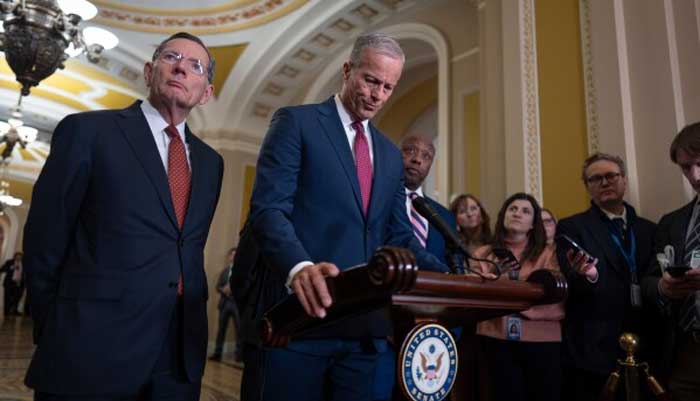
A similar resolution in the Senate failed by a 47–53 vote.
Chuck Schumer, the Senate Democratic leader, urged lawmakers to oppose what he described as another “forever war” in the Middle East.
But John Barrasso, a senior Republican, accused Democrats of putting politics ahead of national security.
“Democrats would rather obstruct Donald Trump than obliterate Iran’s national nuclear program,” he said.
The Senate vote saw Rand Paul join Democrats in supporting the resolution, while Democrat John Fetterman voted against it.
Comments are closed.