

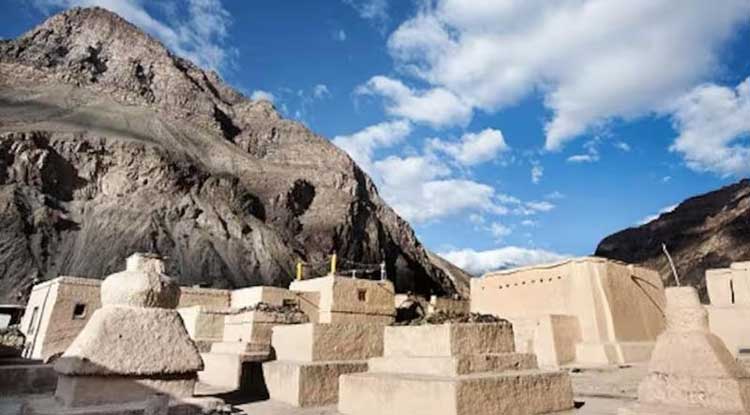
Nestled in the stark cold desert of Spiti Valley in Himachal Pradesh, the ancient Tabo Monastery—often called the “Ajanta of the Himalayas”—is facing an increasing threat from changing climate patterns. Local residents and monastery authorities have raised alarm over the steady deterioration of the nearly 1,000-year-old mud structure and its priceless murals, urging urgent conservation efforts.
A recent meeting in Tabo village brought together community representatives, monastery authorities and officials from the Archaeological Survey of India from Delhi and Shimla to discuss the monastery’s worsening condition. The discussions focused on the need for structural protection, scientific conservation and modern preservation techniques to safeguard the globally significant heritage site.
Built primarily from rammed earth, the monastery has historically survived Spiti’s harsh but extremely dry climate. However, residents say weather patterns have changed significantly in recent years. The region—traditionally a cold desert receiving barely 4–5 centimetres of rainfall annually—has begun witnessing sudden and intense downpours.
These heavy rains are damaging the fragile mud architecture. The outer walls have started eroding, while moisture seepage is gradually affecting the centuries-old murals and wall paintings inside the temple complex. Locals fear that without timely intervention, the monastery could suffer irreversible damage.
Community leaders from villages under the Tabo panchayat, along with the chief lama of Tabo Gompa and several representatives, participated in the meeting and highlighted the urgency of addressing climate-related risks. They stressed the need for swift and concrete action to protect the historic structure.
Residents have proposed installing a protective roofing system over the monastery complex to shield it from heavy rainfall. According to them, such a structure could help preserve the delicate mud walls and the world-renowned murals that form the spiritual and artistic identity of the monastery.
Chhewang Tandin, a community member associated with the monastery, emphasised the importance of cultural heritage, quoting Jamaican activist Marcus Garvey: “A person without the knowledge of their past history, origin and culture is like a tree without roots.” He said the monastery is not just a religious institution but also a living symbol of the region’s identity and history.
Founded in 996 CE by the Tibetan Buddhist translator Rinchen Zangpo under the patronage of the Guge kingdom ruler Yeshe-Ö, Tabo Monastery is regarded as the oldest continuously functioning Buddhist institution in both the Himalayas and India. For centuries, it has served as a major centre of Buddhist learning, drawing disciples from across the world.
The monastery complex consists of nine temples, decorated stupas and cave shrines. Its walls are adorned with ancient frescoes and murals from the 10th and 11th centuries that depict stories from Buddhist traditions. The site also houses rare manuscripts, thangka scroll paintings and sculptures reflecting the rich heritage of Trans-Himalayan Buddhism.
Despite surviving natural calamities, historical invasions and the devastating 1975 Kinnaur earthquake, locals say the monastery now faces an unprecedented challenge from climate change. Restoration work was carried out after the earthquake, including the construction of a new assembly hall in 1983, but experts believe modern conservation measures are now essential.
The monastery also holds deep spiritual significance. The 14th Dalai Lama conducted the Kalachakra Ceremony here in 1983 and again in 1996, drawing thousands of followers.
Residents hope that timely intervention by the ASI and conservation experts will help preserve this millennial monument—considered the cultural and spiritual heart of Spiti—for future generations. Without urgent action, they warn, the fragile mud structures and priceless murals that define Tabo Monastery could gradually be lost to the region’s changing climate.
Guarding the ‘Ajanta of the Himalayas’
-
Perched in the cold desert of Spiti, the nearly 1,000-year-old Tabo Monastery is confronting an unexpected threat from climate change.
-
Once protected by the region’s dry climate, the mud-built complex is now suffering damage from sudden heavy rainfall and moisture seepage.
-
Residents and monastery authorities have urged urgent scientific conservation and protective roofing to safeguard the fragile walls and priceless murals.
Comments are closed.