
NCERT apologises for controversial Class 8 judiciary chapter, withdraws textbook

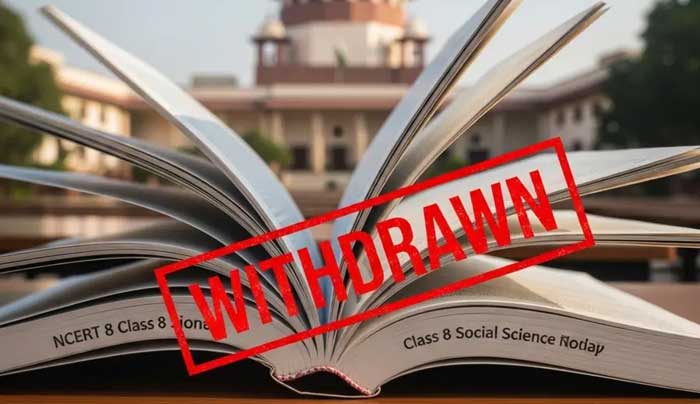
The National Council of Educational Research and Training (NCERT) on Tuesday issued an “unconditional and unqualified apology” over a chapter on the judiciary in its now-withdrawn Class 8 Social Science Part 2 textbook.
The apology came a day before the next hearing in a suo motu case taken up by the Supreme Court of India regarding the textbook. On February 26, the court ordered the immediate seizure of physical copies and removal of digital versions of the book that contained a section on “corruption in the judiciary”, and scheduled the next hearing for March 11.
In its statement, NCERT said the entire book had been withdrawn and was no longer available. “The director and members of NCERT hereby tender an unconditional and unqualified apology for the said Chapter 4,” it said.
In a post on X, the council expressed regret for the inconvenience caused and thanked stakeholders for their understanding. “NCERT remains committed to maintaining the highest standards of accuracy, sensitivity and responsibility in educational content,” it added.
The Part 2 textbook — titled Exploring Society: India and Beyond — was released on February 23 and contained a section discussing “judicial corruption”. The book was withdrawn on January 24, just hours after 32 copies had reportedly been sold.
The Supreme Court took suo motu cognisance of the issue on February 25. NCERT that day apologised for the “inappropriate content” in the chapter titled “The Role of the Judiciary in Our Society” and said it would be rewritten in consultation with relevant authorities.
On February 26, the court issued show-cause notices to the NCERT director and the school education department secretary, asking why criminal contempt proceedings should not be initiated against them. The court said it was “shocked” by media reports about the February 2026 publication.
It noted that while discussing the role of the judiciary, the chapter prominently referred to complaints against judges and alleged inaction, without adequately highlighting the judiciary’s role in protecting constitutional morality, the basic structure doctrine, legal aid and access to justice.
The court said that, on a prima facie reading, the content — along with the director’s administrative response defending it — suggested “a calculated move to undermine the institutional authority and demean the dignity of the judiciary”.
At the same time, the court clarified that the proceedings were not intended to “stifle any legitimate critique”. However, it warned that exposing students in their formative years to a “biased narrative” could create lasting misconceptions.
The court also cited the “serious consequences” and the “everlasting impact” such content could have on the independence and autonomy of the judiciary. It said the conduct could fall within the definition of criminal contempt as it appeared to scandalise the institution and interfere with the administration of justice.
The court directed NCERT, in coordination with Union and state education departments, to ensure that all physical and digital copies of the book are immediately removed from public access. It also banned further production and distribution of the textbook, warning that any attempt to circulate it would amount to a wilful breach of its order.
Comments are closed.