
Hanging glaciers pose serious threat to millions in Himalayas: Study

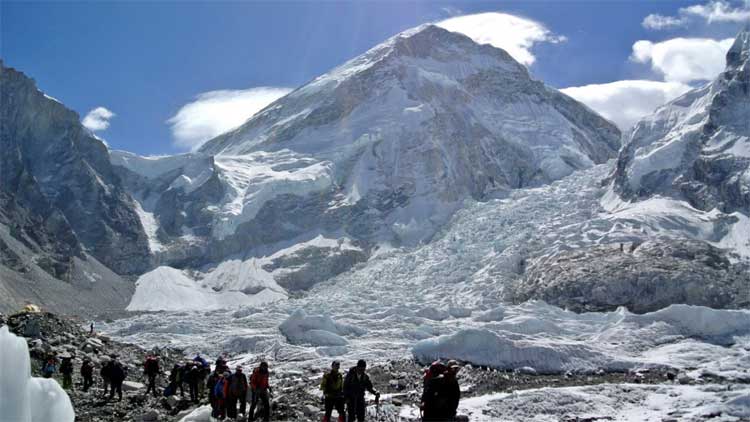
An ongoing study by glaciologists has raised alarm over at least 858 “hanging glaciers” spread across the 2,500-km-long Himalayan range in India, warning of a significant threat to millions living in downstream villages, towns and settlements.
Hanging glaciers, typically small and located on steep mountain slopes or cliff edges, are inherently unstable and highly vulnerable to climate change. Experts say that when these glaciers collapse, they can unleash massive volumes of ice and water, causing devastating floods and destruction.
Scientists have cautioned that the risk is particularly high during the summer months, when accelerated melting increases the likelihood of glacier break-offs. The presence of tourists and local populations in larger numbers during this season further raises the potential for casualties. Rising temperatures in the Himalayas have intensified this hazard, they added.
Data compiled over the past two years by researchers at the Divecha Centre for Climate Change (DCCC) in Bengaluru shows that of the 858 hanging glaciers identified, 99 are located in the Yamuna basin, 219 in the Alaknanda basin, 261 in the Bhagirathi basin and 279 in the Kali basin. Together, these glaciers store an estimated 3,236 gigatonnes of water.
Further analysis indicates that glaciers in the Indus basin hold around 2,103 cubic km of water, while those in the Ganga basin contain about 596 cubic km, and the Brahmaputra basin around 897 cubic km.
Glacier expert Dr Anil V Kulkarni from the Indian Institute of Science said the potential damage from a collapsing hanging glacier is difficult to quantify, as it depends on factors such as glacier size, season and population presence in affected areas.
He also highlighted the role of permafrost degradation — the thawing of permanently frozen ground — in destabilising these glaciers. “Understanding these processes is critical for ensuring the safety of vulnerable communities, but limited infrastructure and manpower remain major challenges,” he said.
Researchers are now developing models to better predict which parts of glaciers are most prone to melting and collapse, in an effort to assess risks more accurately.
The dangers posed by hanging glaciers were starkly illustrated by the November 7 disaster in the Rishi Ganga Valley, which left 72 people dead and over 200 missing.
In response to the growing threat, officials from the National Disaster Management Authority (NDMA), along with representatives from the Ministry of Water Resources, Ministry of Earth Sciences and scientists from IISc, recently held a high-level meeting. During the discussions, an immediate alert was issued regarding a hanging glacier in the Badrinath region.
Experts at the meeting stressed the need to move beyond traditional approaches and establish high mountain regulation zones to better manage development in vulnerable areas. They also called for a comprehensive assessment of cryosphere changes — including glaciers, snow and permafrost — to understand their long-term impact on the Himalayan region.
Comments are closed.