

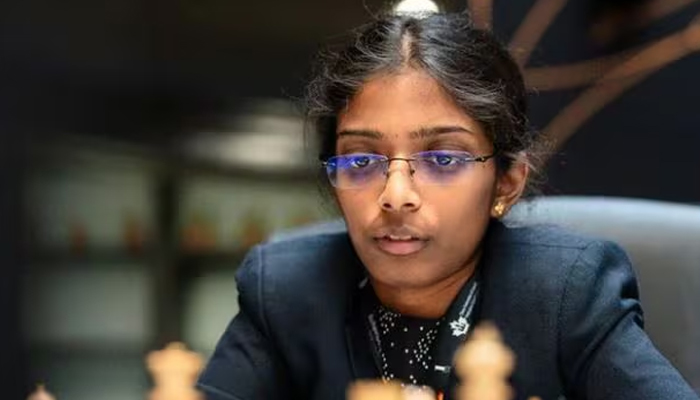
It is never easy to share space with a sibling whose brilliance invites constant comparison.
For many, it shows up in small, familiar ways—a question from a teacher, a casual remark at home, a quiet suggestion that someone else might have done it better. For 24-year-old Grandmaster R Vaishali, that comparison was never far away. For years, she was introduced to many as the sister of R Praggnanandhaa, even as she carved out a formidable career of her own.
In Cyprus, that changed.
By winning the Women’s Candidates 2026, Vaishali became only the second Indian woman after Koneru Humpy to reach the World Championship match. She will now face reigning champion Ju Wenjun later this year, with the title at stake.
She began the tournament as the lowest-rated player in the field, an outsider in a lineup of established contenders. Over 14 rounds, she built her campaign on resilience—absorbing a crucial loss in Round 12 before responding under pressure, defeating Kateryna Lagno in the final round to clinch the title by half a point.
It was a performance that went beyond results. It was about stepping out of a narrative that had followed her for years.
- Beyond the comparisons
- In Vaishali’s story, comparisons were almost inevitable.
Praggnanandhaa’s rise came early and fast, making him one of the most celebrated young talents in world chess. Vaishali’s journey unfolded differently—steady, demanding, and often judged against timelines set by others.
Yet, hers was the first move.
Introduced to chess as a child, she set the path that her younger brother would eventually follow. Both trained under R. B. Ramesh and Aarthie Ramaswamy in Chennai before joining the WestBridge Anand Chess Academy, guided by Viswanathan Anand.
There was a time when she led the way in ratings too. But as Praggnanandhaa’s meteoric rise captured global attention, the spotlight shifted. For a period, it weighed on her. Then, she adapted.
- Holding her ground
- The Candidates demanded everything she had built.
Vaishali grew into the tournament, eventually taking the lead before suffering a setback at a critical stage. What followed defined her campaign—not the loss, but the response.
She reset, steadied herself, and delivered in the final round when the stakes were absolute.
That composure was no accident. In the lead-up, her preparation extended beyond the board—structured routines, mental conditioning, and a renewed focus on balance helped her navigate pressure moments.
- The bond that endures
- If Cyprus marked her emergence, it also revealed something deeper.
After the final round, waiting outside the playing hall were her mother and brother. Praggnanandhaa, despite his own difficult tournament, was there to support her.
Later, Vaishali made sure to acknowledge his role in her campaign—highlighting the conversations, the encouragement, and the quiet presence during tense moments.
It was a reminder that behind the comparisons lies a shared journey.
A name of her own
Breaking out of a narrative is rarely a single moment. It is a process—built over years of persistence, setbacks, and quiet progress.
Vaishali’s victory in Cyprus feels like that moment of arrival. The World Championship match against Ju Wenjun will present her biggest challenge yet. And fittingly, her brother may stand beside her once again, this time in her corner.
But one thing has already changed.
Rameshbabu Vaishali will no longer be introduced through someone else’s story. She has written her own.
Comments are closed.