
“Afghans in Kabul Struggle Amid Severe Water Crisis After Pipelines Cut”

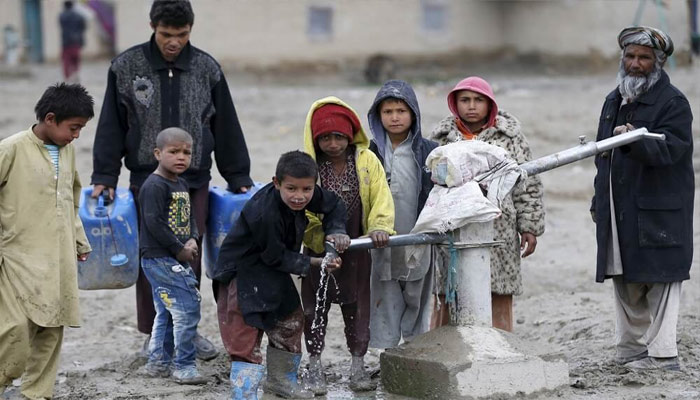
Residents in Kabul are facing a deepening water crisis, with many forced to carry heavy containers over long distances or rely on costly trucked-in supplies as groundwater levels continue to fall sharply.
In Deh Mazang, a poorer neighbourhood on a steep hillside in the Afghan capital, residents describe daily struggles to access even basic drinking water. “You see this hair? Even I, with my white hair, have to carry water,” said 52-year-old Marofa, pointing to her grey strands as she stood in a muddy lane. “These containers are heavy. We have no strength left in our backs, no strength left in our legs.”
While a nearby mosque has a well offering free water, residents say it is not fit for drinking due to its yellowish, brackish quality. As a result, many depend on water delivered on three-wheeled motorcycles and sold at prices that are often unaffordable.
“We have no money for food. How can we get water?” said 90-year-old Wali Mohammad, expressing frustration at the worsening conditions. Both residents said that months after the Taliban took control in 2021, authorities cut off pipes that some households had installed to draw water from a communal well. Mohammad claimed no explanation was given.
“They cut off our water. They are powerful and they don’t even give us a reason why,” he said.
However, another resident, 32-year-old Najibullah Rahimi, said the informal pipes had lowered the well’s water level, leaving uphill residents without access. “So the government came and cut the pipes,” he said. Kabul, located in a high-altitude valley in the Hindu Kush mountains, is increasingly running out of water. The city depends largely on groundwater, but levels have been declining at an alarming pace. In some areas, wells must now be drilled as deep as 150 metres to reach water.
A report by aid group Mercy Corps in April 2025 warned that Kabul’s aquifers have dropped by 25–30 metres over the past decade, raising fears of a major humanitarian crisis if the trend continues. Experts say climate change is worsening the situation, with reduced snowfall limiting natural groundwater recharge. Instead, sudden heavy rains often lead to flooding rather than soaking into the soil.
But they stress that climate change is only part of the problem. Rapid population growth and urbanisation have intensified pressure on already strained water systems. Kabul’s population has more than doubled in two decades, rising from about 2.5 million in 2001 to an estimated 6 million today.
Water expert Najibullah Sadid said unregulated extraction, combined with shrinking natural recharge areas, has pushed parts of the city into severe scarcity. In some areas, shallow aquifers have already dried up. Officials acknowledge the crisis. Ministry of Water and Energy spokesperson Qari Matiullah Abid called the situation “critical,” citing rising demand, reduced rainfall, and population growth.
The government says it has introduced restrictions on groundwater extraction for commercial users, installed water meters, and set usage quotas for high-consumption businesses. It has also built small check dams, absorption wells, and recently completed the Shah wa Arous Dam.
However, experts say these measures are not enough. Two major long-term projects—a pipeline from the Panjshir River and the Shah Toot Dam—remain delayed due to funding and technical hurdles. Together, they could significantly ease Kabul’s water shortage, but construction timelines remain uncertain.
Experts argue that essential water infrastructure has long been overlooked in favour of more visible projects such as roads and flyovers. “Water is more important than roads,” said Sadid, warning that without urgent large-scale intervention, Kabul’s water crisis will continue to worsen in the coming years.
Comments are closed.