
India Successfully Tests MIRV-Capable Agni-5 Missile in Major Strategic Boost

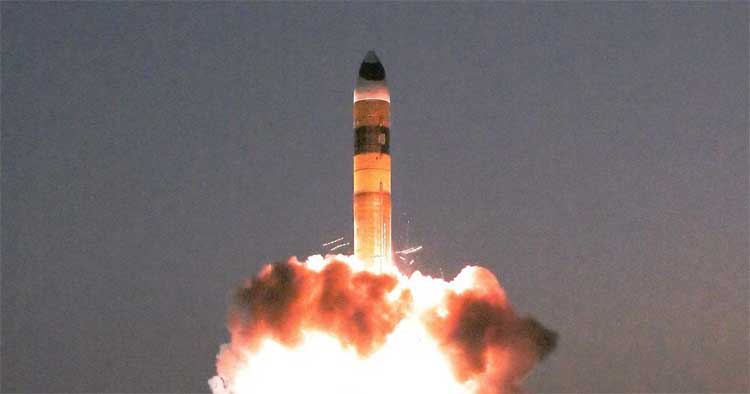
India on Saturday successfully conducted a flight trial of the advanced Agni-5 missile equipped with multiple independently targetable re-entry vehicle (MIRV) technology, marking another major milestone in strengthening the country’s strategic deterrence capability.
The test was carried out on Friday from Dr APJ Abdul Kalam Island off the Odisha coast. The defence ministry said the missile was successfully flight-tested with multiple payloads directed at different targets spread across a vast geographical area in the Indian Ocean Region, with all mission objectives achieved.
Telemetry and tracking were conducted through multiple ground- and ship-based stations, which monitored the missile’s trajectory from launch to impact. The successful trial once again demonstrated India’s ability to strike multiple strategic targets using a single missile system.
MIRV technology enables a missile to carry and deploy several nuclear warheads, each capable of hitting different targets hundreds of kilometres apart. While officials did not disclose the exact number of warheads the Agni-5 can carry, defence experts estimate it can accommodate four to five.
Defence Minister Rajnath Singh said the achievement significantly boosts India’s defence preparedness amid evolving security challenges.
India had first tested the Agni-5 missile with MIRV capability in March 2024 under Mission Divyastra, a codename announced by Prime Minister Narendra Modi. The success placed India among a select group of nations with operational MIRV capability, including the US, UK, France, Russia and China.
The Agni-5, powered by a three-stage solid-fuel engine, has a strike range of over 5,000 km. It forms the most advanced platform in India’s Agni missile series developed by the Defence Research and Development Organisation (DRDO), which also includes Agni-1, Agni-2, Agni-3 and Agni-4.
Equipped with indigenous avionics and high-precision sensor systems, the Agni-5 MIRV project highlights India’s growing technological self-reliance. The maiden 2024 test was notably led by a woman scientist from DRDO.
India’s nuclear doctrine, established in 2003, follows a “no first use” policy, allowing nuclear retaliation only in response to a nuclear attack on Indian territory or forces. Such retaliation must be authorised by the civilian-led Nuclear Command Authority chaired by the Prime Minister.
The latest missile test comes as India continues to strengthen its nuclear triad — the capability to launch nuclear weapons from land, air and sea. This was reinforced in April with the commissioning of INS Aridaman, India’s third nuclear-powered ballistic missile submarine.
According to the Stockholm International Peace Research Institute (SIPRI), India possessed an estimated 180 nuclear warheads as of January 2025, compared with Pakistan’s 170 and China’s 600.
Comments are closed.