

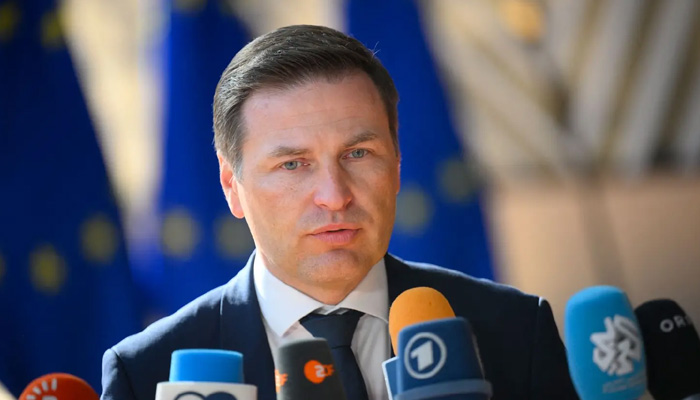
Estonia Defence Minister Quits Over €70 Million Ammunition Deal Involving Indian-Owned Firm
Estonia’s Defence Minister Hanno Pevkur has resigned amid mounting controversy over a €70 million (more than Rs 768.50 crore) ammunition procurement deal intended to supply military aid to Ukraine.
Pevkur, who has served as defence minister since 2022, announced his decision on Wednesday after a critical review by Estonia’s National Audit Office raised questions over defence procurement and the handling of public funds.
Taking political responsibility for the wider defence sector, Pevkur said the country’s security was a collective responsibility and that he would eventually hand over the defence portfolio to Prime Minister Kristen Michal.
CONTROVERSIAL DEAL INVOLVES INDIAN-OWNED COMPANY
The controversy centres on contracts signed in 2024 between Estonia’s Centre for Defence Investments (RKIK) and Datasel SRL, an Italian-registered company acquired earlier that year by India’s Neco Defence Munitions.
Estonia sought artillery shells from the company as part of its efforts to support Ukraine, which was facing significant ammunition shortages.
The procurement was financed using money from the EU’s European Peace Facility. Estonia made a series of advance payments after signing its first contract with Datasel in August 2024.
A further agreement followed in October, with additional contracts signed later in the year. The total advance payments eventually reached approximately €70 million.
However, deliveries did not proceed as initially planned. Supplies were delayed because of reported production difficulties, and ammunition delivered in 2025 was subsequently reported to have failed to meet some quality requirements.
DATASel CHALLENGES CONTRACT TERMINATION
Datasel has disputed Estonia’s handling of the procurement and is pursuing legal action against the country, with the disagreement now before international arbitration.
The company says it supplied approximately €59 million worth of ammunition and received around €59 million in advance payments. It rejects claims that its products were of inadequate quality and argues that Estonia’s termination of the contracts was unjustified.
Datasel has also maintained that it remains willing to complete the agreements if Estonia fulfils its own contractual obligations.
RKIK terminated the contracts last autumn and demanded the return of the advance payments. Estonia has since taken the dispute to the European Arbitration and Mediation Centre in Strasbourg as it seeks to recover the money.
Elmar Vaher, RKIK’s director general, acknowledged that the deal should not have been signed, saying the company’s lack of previous experience in producing or supplying artillery ammunition should have been a warning sign.
AUDIT RAISES CONCERNS OVER DEFENCE SPENDING
The ammunition controversy comes alongside wider criticism of Estonia’s defence spending and procurement procedures.
A National Audit Office report published on August 28 highlighted shortcomings in the management of defence funds and the accounting of assets. The watchdog also warned that Estonia could ultimately have to cover the €70 million from its own budget if the EU funding cannot be recovered.
Pevkur argued that the defence minister does not personally negotiate individual procurement contracts or oversee every purchase. Nevertheless, he said the audit findings raised important questions about political responsibility.
The European Commission has also been in contact with Estonia regarding the disputed funding. Brussels has said mechanisms are available to protect EU funds and recover money if it is found to have been improperly used.
PM SAYS PEVKUR WAS NOT PERSONALLY AT FAULT
Prime Minister Kristen Michal had previously indicated that he did not believe Pevkur was personally responsible for the procurement problems, although he acknowledged that political accountability could still apply.
Pevkur maintained that Estonia had made the right strategic decisions to strengthen its defence capabilities since Russia’s full-scale invasion of Ukraine in 2022.
He also stressed that supporting Ukraine remains important to Estonia’s own security interests.
A NATO and EU member bordering Russia, Estonia has strongly backed Ukraine since the start of the war. The procurement controversy now puts renewed focus on how the Baltic nation manages the rapidly increased defence spending undertaken in response to the regional security threat.
Comments are closed.