

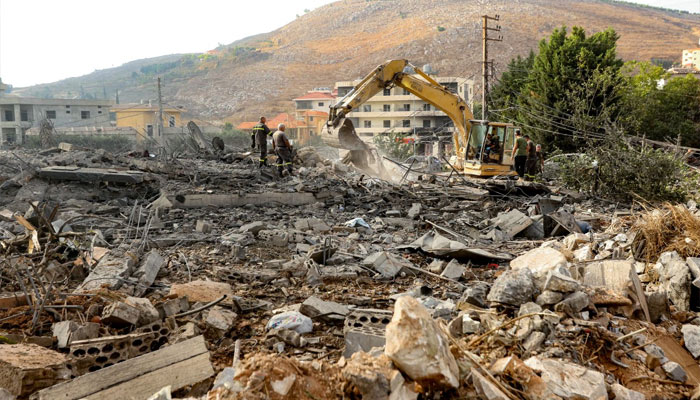
Israeli Strikes Kill 27 in Southern Lebanon, Injure 69 as Nabatieh Faces Renewed Displacement
At least 27 people have been killed and 69 wounded in a three-day wave of Israeli attacks across southern Lebanon, with women, children and paramedics among the casualties. The strikes have intensified around Nabatieh, where residents described the bombardment as a “ring of fire.”
Lebanon’s Health Ministry said 12 people were killed and 10 injured when an Israeli airstrike hit a residential house in Kafr Rumman, a densely populated town near the strategically important Ali Al-Taher heights, north of the Litani River. The victims included two children and four women. Three children were among the wounded, while a paramedic injured in the attack was later killed in a separate strike targeting a vehicle in the town.
Israeli attacks over the weekend also hit Arab Salim, Nabatieh and its outskirts, Mayfadoun, Al-Kfour and Al-Ramadiyah. Eleven people were killed and 26 wounded in those strikes, while another round of attacks from Friday night into Saturday left four dead and 32 injured.
Among the latest victims was Hiba Ali Sabah, an employee of Lebanon’s Labor Ministry. Labor Minister Mohamad Haidar said Sabah was killed along with her husband and daughter when a residential building in Kafr Rumman was struck early Monday. Other members of her husband’s family were also killed.
Heavy explosions were reported across southern Lebanon on Monday, including in the coastal town of Al-Mansouri near Tyre and the border town of Hula, where homes were destroyed. In Deir Al-Zahrani, the Israeli military issued an evacuation warning for a building overnight before destroying it about 22 minutes later.
The attacks have triggered fresh displacement from villages in Nabatieh district and nearby areas, adding to concerns over the durability of the already fragile ceasefire.
Israeli army spokeswoman Ella Waweya said the strikes were carried out after Hezbollah allegedly launched an explosive-laden drone toward Israeli forces, which Israel described as a “flagrant violation” of the ceasefire. She said the military had responded with force against the group.
The escalation came less than a day after Israeli forces struck the Finance Ministry building in Nabatieh and Ghandour Hospital. Haidar condemned the strikes as violations of international rules and conventions and urged the international community and relevant organizations to intervene.
The situation has also exposed growing tensions within southern Lebanon over Hezbollah’s role. Activists from Nabatieh and surrounding areas warned that the district could face widespread destruction and displacement, saying residents were being left between fear, uncertainty and repeated displacement.
The activists blamed Israel for the attacks but also criticized those responsible for decisions on war and security inside Lebanon. They called for authority over war and peace to be placed exclusively in the hands of the Lebanese state.
The controversy has intensified after the Israeli military announced that it had taken control of the Ali Al-Taher heights, a key strategic position overlooking Nabatieh. Hezbollah had reportedly established fortified military installations and a command center in the area.
Lebanese authorities had previously proposed transferring control of the heights to the Lebanese army, but Hezbollah rejected the proposal, saying it would not surrender its weapons north of the Litani River.
The activists said the fall of Ali Al-Taher demonstrated the consequences of keeping security decisions outside state institutions. They urged the Lebanese government and army to take immediate steps to protect Nabatieh and surrounding villages and prevent further Israeli expansion.
Prime Minister Nawaf Salam spoke with Nabatieh Mayor Abbas Fakhr El-Din and reaffirmed the government’s commitment to supporting displaced residents, facilitating their return and maintaining essential public services.
Parliament Speaker Nabih Berri accused Israel of committing “acts of state terrorism” and said it had failed to honor ceasefire arrangements. He also accused Israel of turning southern Lebanon and its residents into targets amid rising political tensions ahead of elections.
Meanwhile, Israel’s public broadcaster reported that the military was awaiting political approval to destroy tunnels in the Ali Al-Taher area. After the operation, Israeli forces are expected to withdraw from the Yellow Line and reposition along the Gray Line, reportedly between 2 km and 4 km from the Israeli border.
Comments are closed.