
‘Elections Are Being Rigged’: Rahul Gandhi Targets CEC Gyanesh Kumar Over ‘Vote Chori’

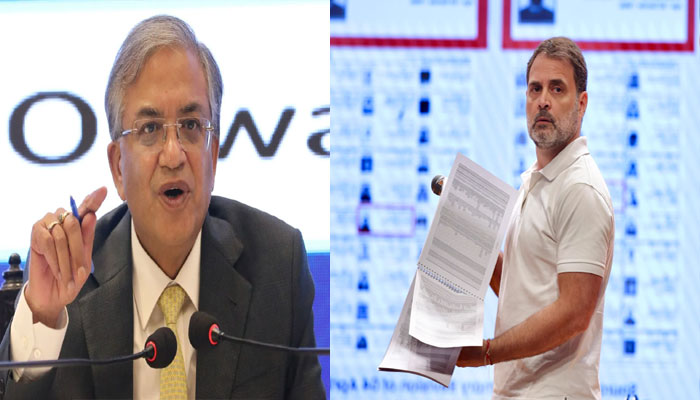
Rahul Gandhi Demands CEC Gyanesh Kumar’s Resignation, Repeats ‘Vote Chori’ Allegation
Leader of Opposition in the Lok Sabha Rahul Gandhi on Wednesday stepped up his criticism of the Election Commission, demanding the resignation of Chief Election Commissioner Gyanesh Kumar and reiterating his allegation of “vote chori” in Indian elections.
Gandhi’s remarks came after The Indian Express reported that Election Commissioners Sukhbir Singh Sandhu and Vivek Joshi had recorded objections to decisions taken in the name of the poll panel on at least 14 occasions over a 10-month period.
Referring to the report, Gandhi said the objections raised by the two Election Commissioners were significant and urged Gyanesh Kumar to reconsider his position.
“I have shown it with proof, and there is already more than enough information to make this a 100 per cent certainty that Indian elections, Lok Sabha elections, 2024 election, Vidhan Sabha elections are all being rigged,” Gandhi said.
He also praised Sandhu and Joshi for recording their objections, saying they had “done a wise thing”. Gandhi called on the CEC to “think seriously and turn approver”.
Gandhi Questions CEC Appointment Process
Gandhi also revisited his opposition to the process through which Gyanesh Kumar was appointed Chief Election Commissioner.
He said he had submitted a dissent note during the appointment process, arguing that the Election Commission should remain independent and free from executive control. According to Gandhi, his objections were “junked”.
Under the Chief Election Commissioner and Other Election Commissioners Act, 2023, the selection committee comprises the Prime Minister, the Leader of Opposition in the Lok Sabha and a Union Cabinet minister nominated by the Prime Minister. The committee recommends candidates to the President for appointment.
‘How Does Anti-Incumbency Disappear?’
Gandhi also raised questions about electoral trends in several states, particularly where governments had historically faced changes in power.
Citing Haryana, Maharashtra, Uttar Pradesh, Madhya Pradesh and Gujarat, he questioned what he described as the disappearance of anti-incumbency in recent elections.
“Haryana swings from one party to another for 50 years. Suddenly anti-incumbency disappears. Maharashtra swings; suddenly it disappears. Uttar Pradesh swings. Sometimes Samajwadi, sometimes BSP; it disappears. Madhya Pradesh, it disappears. Gujarat, it disappears. This has been a fundamental question for us,” he said, according to ANI.
Gandhi said the Opposition could assess a leader’s popularity and the performance of a government but claimed it had difficulty explaining what he described as a sudden change in voting patterns.
Gandhi Links ‘Vote Chori’ To Institutions
Expanding on his allegation, Gandhi said concerns over electoral processes could have wider implications for governance.
“From vote-chori comes Kanun-chori…. From Kanun-chori comes Sanstha chori — institutions. This is the chain that has taken place,” he alleged.
He further argued that if elected representatives had entered Parliament on the basis of manipulated votes, then questions could subsequently arise over the legitimacy of laws and institutional changes made by them.
Gandhi has repeatedly made allegations of electoral irregularities, particularly in relation to voter rolls and elections in Haryana and Maharashtra. The Election Commission has rejected such allegations and maintained that its electoral processes are conducted according to law.
BJP Hits Back At Rahul Gandhi
BJP national spokesperson Pradeep Bhandari rejected Gandhi’s remarks and criticised his claims about anti-incumbency.
In a post on X, Bhandari said Gandhi’s assertion that there had been no anti-incumbency against the BJP since 2014 was incorrect, pointing to elections the party had lost during that period.
He also referred to Congress victories in Rae Bareli while questioning Gandhi’s allegations of electoral manipulation.
The exchange comes amid an intensifying political dispute over the functioning of the Election Commission, including the Special Intensive Revision of electoral rolls and reported differences among members of the poll panel.
Comments are closed.