
Midnight Showdown in Poland: Police Guard Court as President Returns, Coup Allegations Trigger Political Turmoil

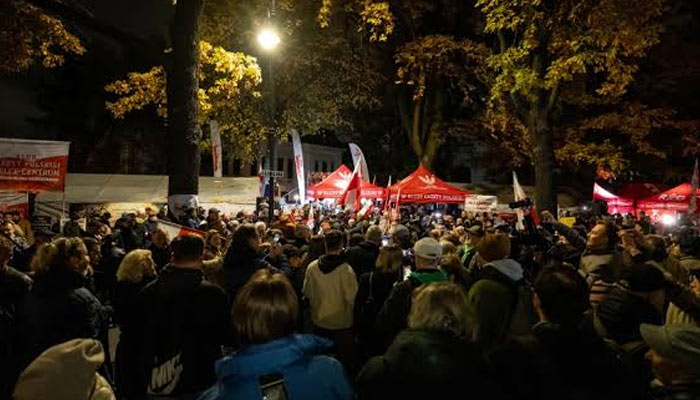
Poland’s Constitutional Showdown Escalates: Police Guard Court as President Rushes Back from Senegal
Poland witnessed an extraordinary political confrontation after riot police surrounded the Constitutional Tribunal, demonstrators clashed with security personnel and President Karol Nawrocki abruptly abandoned his overseas visit to return to Warsaw. The developments have intensified a bitter power struggle between Prime Minister Donald Tusk’s government and the opposition Law and Justice (PiS) party over the country’s judicial system.
The situation escalated when protesters breached the court’s perimeter fence and threw objects at police officers. Riot police were deployed to control the gathering, and three people were detained during the confrontation.
Amid the growing tensions, President Nawrocki decided to cut short his visit to Senegal, where he was scheduled to attend the Summer Youth Olympic Games in Dakar.
Explaining his decision, Nawrocki wrote on X: “At a moment like this, the President must be in Poland. I am cutting short my flight to Senegal. I am returning.”
His chief of staff subsequently confirmed that the president had entered the Constitutional Tribunal, drawing further attention to the unfolding political crisis.
What Triggered the Confrontation?
The immediate controversy involves Constitutional Tribunal President Bogdan Swieczkowski and Vice-President Bartlomiej Sochanski.
Justice Minister Waldemar Zurek has sought to remove their immunity from prosecution, paving the way for criminal proceedings against the two senior judicial officials. The government alleges that they prevented judges elected by the current parliamentary majority from participating in the tribunal’s work.
The move has provoked strong opposition from PiS leaders, who accuse Tusk’s administration of interfering with the constitutional order.
The Constitutional Tribunal has defended its leadership, insisting that Swieczkowski and Sochanski continue to hold their legally appointed positions. In a statement on social media, the institution characterised the actions against them as a coup d’etat.
A Long-Running Battle Over Judicial Independence
Poland’s latest political confrontation is connected to a wider dispute over judicial reforms introduced during the PiS government’s rule between 2015 and 2023.
The changes attracted criticism from opposition parties and European institutions, which argued that the reforms weakened judicial independence and increased political influence over the courts.
The European Court of Human Rights and the Court of Justice of the European Union subsequently raised concerns about the appointment of three Constitutional Tribunal judges during the PiS era, ruling that their selection did not meet the required standards because the positions had already been filled by the previous parliament.
Donald Tusk’s government, which took office in 2023, promised to reverse the controversial reforms and restore judicial independence. However, implementing those commitments has proved difficult because of opposition from successive presidents, Andrzej Duda and Karol Nawrocki, who have used their veto powers against proposed changes.
Nawrocki has also refused to swear in five judges elected by parliament since March, questioning the legitimacy of their selection. Meanwhile, Anna Korwin-Piotrowska has been placed in temporary charge of the tribunal.
Suspension of Senior Judge Adds to Legal Confusion
The Constitutional Tribunal’s website published information about Swieczkowski’s suspension on Friday evening. However, the website became unavailable shortly afterwards, preventing independent verification of the official grounds for the decision.
Swieczkowski assumed the tribunal presidency under the PiS administration. Tusk has accused him of obstructing the participation of newly elected judges in the court’s proceedings.
Justice Minister Zurek’s attempt to initiate criminal proceedings against Swieczkowski and Sochanski has further intensified the institutional conflict.
However, the government’s approach has also faced criticism from legal experts. Lawyer Marcin Matczak, who has previously opposed Swieczkowski’s leadership, argued that the suspension had no legal basis. He also warned that the deployment of armed police around the tribunal and questions surrounding the Justice Minister’s authority could have lasting implications for Poland’s legal system.
Earlier this month, the Venice Commission, the Council of Europe’s advisory body on constitutional matters, urged President Nawrocki to swear in the five judges elected by parliament.
Tusk and PiS Exchange Strong Accusations
Prime Minister Tusk has defended his government’s actions, arguing that restoring the rule of law is a constitutional responsibility that cannot be abandoned because of political resistance.
“Restoring the rule of law is our duty. After years of Law and Justice’s lawlessness, this is a difficult, sometimes painful process that requires decisive action. There is no other way,” he wrote on X.
PiS leaders have rejected this justification. Former Justice Minister Zbigniew Ziobro described the action against Swieczkowski as a criminal attack on the constitutional order and called for resistance.
The latest confrontation has also exposed divisions among those who support judicial reform. While some government supporters believe Tusk has moved too slowly in reversing the previous administration’s changes, other critics have questioned whether his government’s methods have a sufficient legal foundation.
With parliamentary elections scheduled for next year, the dispute is adding another layer of political uncertainty in Poland.
The standoff has evolved into a wider institutional battle involving the government, opposition, presidency and judiciary, with competing claims over constitutional authority and the independence of the country’s highest judicial institutions.
Comments are closed.