
UGC Equity Rules Under Review? Centre Tells Supreme Court It May Form Panel to Reassess Regulations

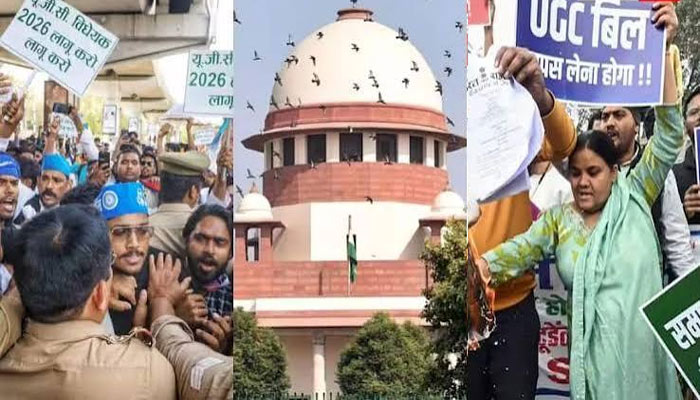
UGC Equity Regulations: Centre Considers Review Committee After Supreme Court Raises Concerns Over 2026 Rules
The Centre is considering forming a committee to examine the University Grants Commission’s (UGC) controversial 2026 equity regulations after the Supreme Court urged the government to revisit the provisions and ensure that students from all communities receive equal protection.
Solicitor General Tushar Mehta informed a three-judge bench on Thursday that the government was contemplating the appointment of a committee to reconsider the regulations, which were put on hold by the Supreme Court on January 29 following multiple legal challenges.
Chief Justice of India Surya Kant, heading the bench along with Justices Joymalya Bagchi and V Mohana, asked the Centre to take another look at the rules, stressing the importance of protecting the interests of every student.
The Chief Justice observed that the regulations should be framed in a manner that addresses discrimination without creating distinctions that could undermine the rights of any section of the student community.
Why Have the New UGC Rules Become Controversial?
The UGC notified the Promotion of Equity in Higher Education Institutions Regulations, 2026, on January 13. The rules were introduced to strengthen safeguards against discrimination in universities and other higher education institutions.
However, several provisions triggered objections from general category organisations as well as sections of Dalit and OBC communities.
The biggest controversy centres on Regulation 3(1)(c), which defines caste-based discrimination as discriminatory treatment based on caste or tribe against members of Scheduled Castes, Scheduled Tribes and Other Backward Classes.
Those challenging the regulations argue that this definition leaves general category students and faculty outside the specific protection provided against caste-based discrimination.
At the same time, another provision defines discrimination more broadly, covering unfair or differential treatment based on caste against any stakeholder in an educational institution.
The conflicting interpretations have prompted questions about the scope of protection and whether the regulations provide an adequately balanced framework.
Supreme Court’s Four Major Concerns
The regulations were challenged in proceedings connected to a 2019 petition filed by the mothers of Payal Tadvi and Rohith Vemula. Both died by suicide following allegations of caste-based discrimination in educational institutions.
Their petition sought stronger institutional mechanisms to prevent discrimination and ensure accountability within higher education establishments.
While staying the new regulations on January 29, the Supreme Court identified several issues requiring examination.
1. Scope of caste-based discrimination
The court questioned whether Regulation 3(1)(c) was reasonably connected to the objectives of the regulations, particularly since no separate procedural mechanism had been prescribed for handling caste-based discrimination.
2. Safeguards for disadvantaged communities
The bench sought clarity on whether the regulations adequately protected the most backward sections within SC, ST and OBC communities against discrimination and structural disadvantages.
3. Segregation in educational institutions
The court examined whether references to segregation in hostel allocation, classrooms, mentorship groups and other academic arrangements could lead to a separate-but-equal system, potentially violating constitutional guarantees under Articles 14 and 15.
4. Exclusion of ragging
Another concern involved the omission of ragging as a specific category of discrimination. The court questioned whether this exclusion could create unequal treatment of victims and affect their access to justice under Articles 14 and 21.
What Happens Next?
The Centre’s statement indicates that the government is considering a fresh examination of the disputed provisions through a committee.
The proposed review could provide an opportunity to address concerns regarding the definition of caste-based discrimination, the protection available to different student groups and the effectiveness of institutional grievance-redressal mechanisms.
For now, the regulations remain stayed following the Supreme Court’s January 29 order. Any decision on their future implementation will depend on the government’s next steps and further judicial proceedings.
The case has brought renewed attention to the challenge of creating effective anti-discrimination safeguards in higher education while ensuring that constitutional guarantees of equality and fairness apply to everyone.
Comments are closed.