
Pakistani Astronaut Makes History as First Foreign National to Join China’s Shenzhou-24 Space Mission

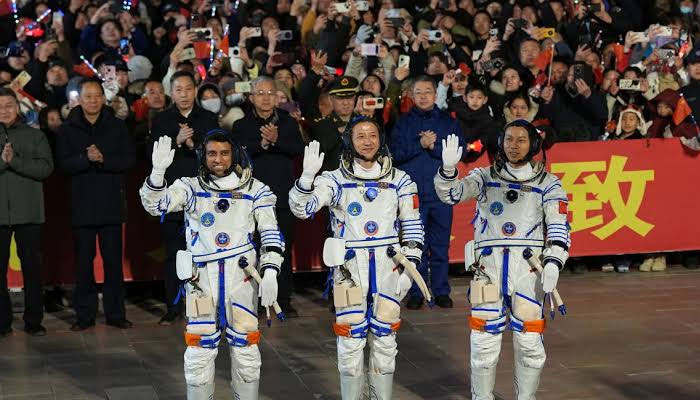
China has taken a major step towards internationalising its space programme with the successful launch of the Shenzhou-24 spacecraft on Wednesday.
The mission has drawn global attention as it carries Pakistani astronaut Zeeshan Ali, who is set to make history as the first foreign national to visit China’s Tiangong space station. The spacecraft blasted off at 8:18 am local time (0018 GMT) from the Jiuquan Satellite Launch Centre in northwest China. It was carried into orbit by a Long March-2F rocket.
Pakistani Astronaut Joins Historic Chinese Space Mission
Forty-year-old Zeeshan Ali, a trained pilot, has been selected as a payload specialist for the mission. He is expected to remain aboard the Tiangong space station for five to 10 days, during which he will carry out scientific experiments and other research activities.
The mission is being led by Chinese astronaut Tang Hongbo, who will serve as commander, while Wu Yi has joined the crew as a flight engineer.
Ali’s participation is a landmark development for Pakistan’s space ambitions and represents China’s first mission to carry a foreign astronaut to its space station.
Speaking to journalists a day before the launch, Ali highlighted the responsibility of representing his country on such an important journey.
“I’m not flying for myself. I carry the name of Pakistan on my shoulder,” he said.
Seven Months of Preparation Before Launch
Ali underwent an extensive seven-month training programme in Beijing to prepare for the mission. His preparations included technical instruction, physical training and intensive Chinese-language classes to ensure smooth communication with the Chinese crew.
Beyond astronaut training, he also familiarised himself with Chinese culture by learning songs, reading poetry, practising calligraphy and playing table tennis.
The preparation was aimed at helping him adapt to the working environment aboard Tiangong and coordinate effectively with his fellow astronauts during the mission.
Tiangong Emerges as a Platform for Global Space Partnerships
China has been increasingly promoting its Tiangong space station as a destination for international scientific cooperation. By bringing foreign astronauts into its human spaceflight programme, Beijing is seeking to expand its role in global space exploration.
The initiative comes at a time when the NASA-led International Space Station is expected to approach retirement around 2030. China’s space station could consequently become an important platform for international research and collaboration in low Earth orbit.
The participation of a Pakistani astronaut in the Shenzhou-24 mission marks a significant moment in China-Pakistan space cooperation and adds a new dimension to the country’s ambitions in human spaceflight.
Comments are closed.