
Ahead of Strikes, Donald Trump Told Iran Attack Was ‘High-Risk, High-Reward’

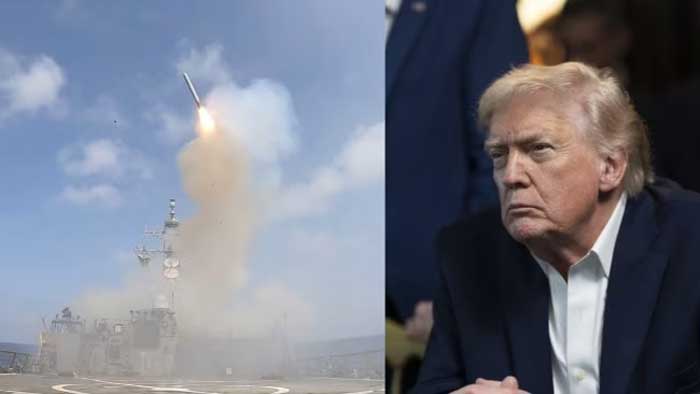
Ahead of the US attack on Iran, President Donald Trump was presented with intelligence briefings that laid out not only the risk of significant American casualties but also the possibility of a dramatic geopolitical shift in the Middle East in Washington’s favor, a US official told Reuters.
The operation — dubbed Operation Epic Fury by the Pentagon — launched Saturday and thrust the region into a volatile new conflict. US and Israeli forces struck targets across Iran, prompting retaliatory missile and drone attacks by Tehran against Israel and US-linked sites in Gulf Arab states.
Speaking on condition of anonymity, the official described the briefings as framing the mission as “high-risk, high-reward,” potentially offering a once-in-a-generation opportunity to reshape regional dynamics.
HIGHLIGHTS
• Trump briefed on risks and strategic opportunities
• Diplomatic efforts with Iran failed to prevent confrontation
• Iran vows sustained retaliation against US and Israeli interests
Trump acknowledged the dangers at the outset, warning that “the lives of courageous American heroes may be lost.”
“But we’re doing this not for now, we’re doing this for the future, and it is a noble mission,” he said in a video address announcing the start of major combat operations. “For 47 years, the Iranian regime has chanted death to America and waged an unending campaign of bloodshed and mass murder … We’re not going to put up with it any longer.”
The internal briefings help explain how Trump arrived at what is arguably the riskiest US military decision since the 2003 invasion of Iraq.
In the days leading up to the strikes, Trump was briefed multiple times by CIA Director John Ratcliffe, Joint Chiefs Chairman Gen. Dan Caine, Secretary of State Marco Rubio and Defense Secretary Pete Hegseth.
On Thursday, Adm. Brad Cooper, head of US Central Command, traveled to Washington for discussions in the White House Situation Room.
A second US official said the White House had been warned of potential Iranian retaliation, including missile barrages targeting US bases that could overwhelm air defenses, as well as attacks by Iranian-backed militias in Iraq and Syria. Despite a significant US military buildup, there were acknowledged limits to the air defense systems rushed into the region.
Experts caution that the conflict could escalate unpredictably. The first official said Pentagon planning did not guarantee a decisive outcome.
Trump publicly called on Iranians to rise up against their government — a prospect analysts say is uncertain. Nicole Grajewski of the Carnegie Endowment for International Peace noted that Iran’s opposition remains fragmented. “It’s unclear what the population is willing to do in terms of rising up,” she said.
The White House did not immediately comment. The Pentagon declined to respond.
Trump’s sweeping objectives
In the weeks before the strikes, Trump ordered a major US military buildup in the Middle East. Reuters previously reported that planning included options for a sustained campaign against Iran, potentially targeting individual leaders.
An Israeli official said Iran’s Supreme Leader Ali Khamenei and President Masoud Pezeshkian were both targeted, though the results remained unclear. Israeli Prime Minister Benjamin Netanyahu later said there were “many signs” that Khamenei “is no longer,” urging Iranians to “take to the streets to finish the job.”
Trump outlined broad goals: eliminating what he described as Iran’s threat to the US, crippling its military capabilities and preventing it from acquiring a nuclear weapon — an ambition Tehran denies.
“We are going to destroy their missiles and raze their missile industry to the ground,” Trump said. “We’re going to annihilate their navy. We’re going to ensure that the region’s terrorist proxies can no longer destabilize the region or attack our forces.”
The move signals a higher tolerance for risk than previous operations under Trump, including a raid in Venezuela last month and earlier US strikes on Iranian nuclear facilities.
Iran’s Revolutionary Guards warned that retaliation would continue until “the enemy is decisively defeated,” threatening US bases and interests across the region.
Analysts say Tehran retains multiple options, from ballistic missile strikes to drone attacks and cyber operations.
Daniel Shapiro, a former senior Pentagon official for Middle East policy and former US ambassador to Israel, said that despite the scale of US and Israeli strikes, Iran could still inflict damage.
“Iran has many more ballistic missiles that can reach US bases than the US has interceptors,” Shapiro said. “Some Iranian weapons will get through. This is a major gamble.”
Comments are closed.