

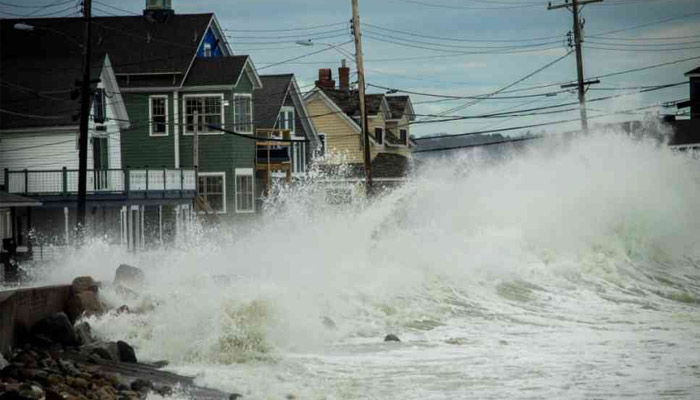
AI Speeds Up and Sharpens Storm Surge Predictions, Offering Critical Lead Time for Coastal Safety.
Storm surges — towering walls of ocean water pushed inland by hurricanes and cyclones — are becoming an increasing threat to coastal regions. Rising sea levels mean these surges now start from a higher baseline, roughly 8 inches above 1900 levels and projected to rise by as much as 8 feet by 2100. The result: more frequent and severe coastal flooding. In the U.S. alone, hurricanes have caused over $1.5 trillion in damage, much of it linked to storm surges. Accurate and timely predictions are crucial to give people time to evacuate and help officials plan effective responses.
AI Takes Forecasting to the Next Level
Until now, storm surge forecasts have relied on complex physics-based models like NOAA’s ADCIRC, which simulate how wind and pressure move water along coastal grids. While reliable, these high-resolution simulations can take many hours to run on supercomputers — too slow for rapidly evolving storm situations.
To overcome this, researchers are turning to artificial intelligence. By training neural networks on data from past storms and existing simulations, AI can act as a “surrogate model,” producing forecasts much faster. These systems take in parameters such as storm track, wind speed, and air pressure to estimate surge heights — often in just minutes. Remarkably, many AI-generated forecasts now match or even exceed traditional model accuracy. Scientists are also feeding AI synthetic hurricane data so it can better handle rare, extreme, or future climate-driven events.
Faster Warnings, Better Preparedness
The practical benefits are significant. AI-powered tools can generate real-time flood maps showing which areas are most at risk, helping communities and emergency teams make faster, better-informed decisions. Some systems are even being trained to assess storm damage from satellite or aerial imagery, filling data gaps for post-disaster analysis.
As AI continues to evolve and integrate with conventional forecasting systems, experts say it could revolutionize coastal preparedness — delivering near-instant storm surge predictions, saving lives, and reducing losses in an era of stronger storms and higher seas.
Comments are closed.