
At Least 64 Dead In Spain Train Crash As Emergency Teams Race To Find Survivors

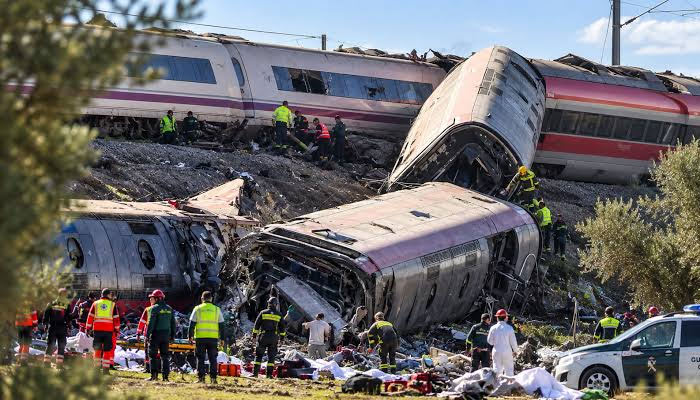
Spain Train Disaster: At Least 64 Dead After Two High-Speed Trains Collide, Rescue Operations Continue
At least 64 people were killed after two high-speed trains collided in Spain’s Toledo province on Wednesday, according to a Reuters report citing Spanish authorities. The deadly crash disrupted rail services connecting Madrid, Ciudad Real and Andalusia, while emergency teams continued searching the wreckage for victims.
The collision triggered a massive rescue operation, with ambulances, helicopters and specialist emergency personnel deployed near the accident site. Images from the area showed evacuated passengers walking along a nearby road, some with bloodied clothes and bandaged injuries, while others carried their luggage away from the damaged trains.
According to Spanish media outlet ABC, volunteers also distributed water donated by neighbouring towns as rescue and relief operations continued.
Several train carriages were severely damaged in the collision. While some remained on an elevated section of track, twisted metal and broken panels were scattered across an embankment below. At least three carriages had plunged down the slope, complicating the rescue effort.
Passenger Recalls Terrifying Moments Before The Crash
Passengers described scenes of confusion and panic following the collision. Miguel, who was travelling with colleagues in the rear carriage of one of the trains, recounted the experience to Spanish radio station COPE.
He described hearing an enormous roar and a powerful impact that lasted several seconds, making it feel as though the train was about to derail. Looking through a window, he said, he could see another badly damaged train.
Rescue workers continued to examine the wreckage as emergency services worked to assist injured passengers and establish the full scale of the disaster.
How Did The Two Trains Collide?
The precise sequence of events remains subject to investigation. According to a person briefed on the incident, as cited by The Associated Press, a train operated by private rail consortium Iryo had stopped near Toledo on the instructions of rail infrastructure manager Adif because of a signal fault.
A train operated by state-owned railway company Renfe subsequently struck the stationary Iryo train at high speed, causing carriages from both trains to derail, the person said.
Renfe stated that its train had been authorised to continue its journey before the collision. The company said the Iryo service had remained stationary for reasons that were not yet known.
In a statement, Renfe said the train had continued as instructed before the collision occurred. It added that investigators would need to establish the exact sequence of events, traffic conditions and circumstances surrounding the impact.
The Associated Press, citing local media reports, said the trains were travelling in the same direction when one struck the rear of the other, knocking two carriages off the tracks.
The cause of the collision has not been conclusively established.
Spain Suspends High-Speed Rail Services
Following the accident, Adif suspended services on the Madrid-Andalusia high-speed railway line. The infrastructure operator announced the disruption in a post on X, describing the incident as a rear-end collision between two trains.
The suspension affected connections between Madrid, Ciudad Real and Andalusia as authorities prioritised rescue operations and assessed the damage to railway infrastructure.
Manuel Galán, mayor of the nearby town of Urda, told Spanish public broadcaster TVE that several passengers had been injured. He added that civil protection authorities had asked the local council to prepare a sports pavilion to accommodate passengers affected by the accident.
Jesús Pérez, mayor of neighbouring Los Yébenes, also described the crash as serious in comments to TVE. Meanwhile, Castilla-La Mancha regional president Emiliano García-Page announced on X that he was travelling to the accident site.
Emergency Teams Mobilised On A Large Scale
Madrid City Council deployed around 100 personnel to support the emergency response, according to local media reports. The deployment included seven fire service vehicles, 16 ambulances and specialist rescue teams.
Two psychologists from Madrid’s emergency service, SAMUR-PC, were also providing assistance at a crisis room established at Atocha railway station to support people affected by the disaster.
As rescue operations continued, emergency personnel worked to locate victims, help survivors and assess the extent of the damage. High-speed rail services on the affected route remained suspended, while investigators faced the task of determining how the two trains came to collide.
The disaster has raised urgent questions about the circumstances surrounding the collision, including the reported signal fault and the movements of both trains before impact. Authorities are expected to establish the sequence of events as the investigation progresses.
Comments are closed.