
Bangladesh Election Results 2026 LIVE: Tarique Rahman Leads in Early Dhaka Trends, BNP Gains Edge

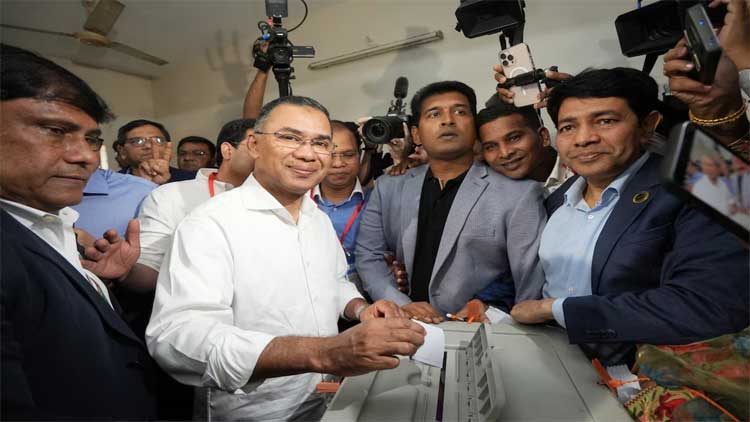
The chairman of the Bangladesh Nationalist Party (BNP) has registered early gains in Bangladesh’s national elections, securing the Dhaka-17 and Bogra-6 constituencies, according to Dhaka Tribune. Vote counting is underway following largely peaceful polling across the country on Thursday, February 12.
Election Commission (EC) Senior Secretary Akhtar Ahmed said voter turnout reached 47.91% by 2pm, with voting officially concluding at 4:30pm local time. Alongside parliamentary voting, Bangladeshis also participated in a National Referendum to decide whether the proposed July National Charter should be adopted.
Hasina Rejects Polls From Exile
Former prime minister Sheikh Hasina, currently in exile in India, dismissed the elections as a “farce” and alleged widespread irregularities.
“From the evening of 11 February, this farce began with seizure of polling centers, gunfire, vote-buying, distribution of money, stamping of ballots, and agents signing result sheets,” Hasina said in a statement posted on X by the Awami League.
She claimed voter participation was “negligible,” arguing that democratic values and constitutional principles had been disregarded. “The people’s voting rights, democratic values, and the spirit of the Constitution were completely disregarded in this deceptive, voter-less election conducted without the Awami League,” she said.
The Awami League was barred from contesting after the Election Commission cancelled its registration, a decision that has significantly reshaped the political landscape.
Candidate Profile and Participation
Although more than 1,900 candidates are contesting seats nationwide, only 109 are women, according to The Daily Star. In total, 1,981 candidates are vying for parliamentary representation.
More than 127 million citizens are eligible to vote in the country of nearly 170 million people. The elections are being overseen by an interim government led by Nobel Peace Prize laureate Muhammad Yunus, which has pledged free, fair, and peaceful polls.
Two-Ballot System: White and Pink
Bangladesh’s election featured a dual-ballot system. Voters cast white ballots for parliamentary candidates and pink ballots for the National Referendum.
The proposed July National Charter outlines governance reforms aimed at strengthening democratic institutions, improving accountability, and preventing what it describes as a “recurrence of authoritarian and fascist rule.”
Main Contenders in a Changed Political Arena
Bangladesh politics has long been dominated by the rivalry between Sheikh Hasina and Khaleda Zia. With the Awami League excluded from the race, the BNP has emerged as the principal contender.
The party has positioned Tarique Rahman — son of former prime minister Khaleda Zia — as its leading figure. Rahman returned to Bangladesh in December after 17 years in self-imposed exile and has campaigned on promises to reinforce democratic institutions, restore the rule of law, and revive economic growth.
The BNP faces competition from an 11-party alliance led by Jamaat-e-Islami. Once banned during Hasina’s tenure, Jamaat has regained political space and is seeking to expand its influence. The alliance also includes the newly formed National Citizen Party, created by Gen Z activists linked to the 2024 uprising.
Youth Vote Seen as Crucial
The elections are widely viewed as Bangladesh’s first genuinely competitive contest in over a decade. Analysts believe young voters could play a decisive role.
“Several factors will shape the outcome, including how Generation Z — which makes up about a quarter of the electorate — votes,” Parvez Karim Abbasi of Dhaka’s Centre for Governance Studies told AFP.
Nearly 5 million first-time voters are participating, adding to the uncertainty surrounding the final outcome.
Key Issues Shaping the Election
Voters are primarily focused on bread-and-butter concerns:
-
Corruption: Surveys indicate corruption remains the top voter concern, with Bangladesh continuing to rank poorly in global corruption indices.
-
Inflation: Official data shows inflation rose to 8.58% in January, intensifying economic pressures.
-
Economic Recovery: Growth has slowed following pandemic-related disruptions, particularly in the garment sector.
-
Employment: With roughly 40% of the population under 30, job creation is a pressing issue.
-
Awami League Ban: Hasina’s exclusion has sparked debate, though analysts do not expect a widespread boycott.
Referendum Adds to Stakes
Beyond parliamentary results, the National Referendum could reshape Bangladesh’s governance framework. Proposed reforms include limits on prime ministerial tenure and stronger checks on executive authority.
The outcome is seen as a test of whether recent political upheaval can translate into lasting institutional change.
When Will Results Be Known?
While unofficial trends have historically emerged by early morning, election officials have cautioned that counting may take longer this year due to the dual-ballot system.
Comments are closed.