
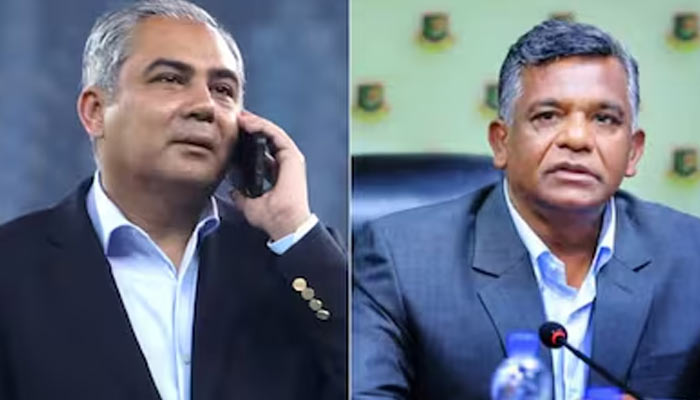
Bangladesh, Pakistan bhai bhai: BCB chief holds talks with Mohsin Naqvi before crucial ICC meeting

Hours before the International Cricket Council is set to hold crisis talks with Pakistan over.
Its boycott of the marquee T20 World Cup clash against India, Bangladesh Cricket Board president Aminul Islam Bulbul arrived in Lahore, signalling a coordinated front between the two boards. Sources told India Today that Pakistan and Bangladesh have effectively “joined hands” as the ICC attempts to broker a last-minute compromise with Mohsin Naqvi’s Pakistan Cricket Board (PCB), hoping to persuade Pakistan to reverse its decision to skip the most lucrative fixture of the tournament.
The ICC meeting, scheduled to be held over Zoom on Sunday evening, February 8, will include ICC CEO Sanjog Gupta, PCB chairman Mohsin Naqvi and Bulbul. The governing body is scrambling to contain a controversy that now threatens to disrupt the tournament schedule and undermine its commercial structure.
India Today has learnt that the PCB is pushing for Bangladesh to be formally included in the negotiations, despite Dhaka having already been dropped from the T20 World Cup after refusing to travel to India for the 2026 edition.
The crisis escalated on February 2, less than a week before the tournament, when Pakistan announced it would not play India on February 15 in Colombo. The decision followed Bangladesh’s refusal to tour India for the World Cup, citing security concerns.
Bangladesh, backed by its interim government, had requested the ICC to shift its matches to Sri Lanka, the tournament’s co-host. The ICC rejected the proposal and replaced Bangladesh with Scotland, triggering a chain reaction that has now drawn Pakistan into open confrontation with the world body.
Why the ICC is stepping in
An India–Pakistan match remains the single biggest revenue driver in world cricket. From broadcast rights to sponsorship and advertising, no fixture comes close in commercial value. The ICC’s urgency reflects fears that Pakistan’s boycott could cause significant financial damage.
Broadcasters pay a premium largely because of marquee encounters like India vs Pakistan. The absence of that match would immediately devalue the tournament’s commercial package, with ripple effects across the ICC’s revenue model. Any reduction in broadcast income would eventually affect the ICC’s annual distributions to member boards — including Pakistan, Bangladesh and India — a scenario the governing body is keen to avoid.
From the ICC’s perspective, the talks are about damage control. Officials are attempting to prevent the situation from escalating into a broader crisis involving financial losses, legal disputes and questions over governance consistency.
Why Bangladesh is involved
Bangladesh’s presence at the negotiation table is particularly striking, given that the team has already been removed from the tournament and will not directly benefit from World Cup broadcast revenues. However, Bangladesh cricket stands to lose in the long run if the ICC’s overall earnings take a hit. Lower ICC revenues would mean reduced future distributions to member boards, including the BCB.
Bangladesh has publicly aligned itself with Pakistan’s stance. Sports Adviser Asif Nazrul thanked Islamabad after Pakistan announced its boycott. “Thank you, Pakistan,” Nazrul wrote on Facebook. “Pakistan Prime Minister Shehbaz Sharif has said that his country has decided to boycott the match against India in protest of Bangladesh being excluded from the T20 World Cup.”
Nazrul serves as sports adviser in Bangladesh’s unelected interim government led by Muhammad Yunus, effectively functioning as the country’s sports minister. The PCB, meanwhile, has said it is acting on instructions from the Sharif government. “We have taken a very clear stand on the T20 World Cup that we won’t play the match against India because there should be no politics on the sports field,” Pakistan Prime Minister Shehbaz Sharif said at a government meeting in Islamabad.
With the ICC now forced into high-stakes negotiations involving multiple stakeholders, Bulbul’s presence in Lahore underlines how far the issue has moved beyond cricket — and how difficult it may be for the world body to enforce consistency without inflaming an already volatile situation.
Comments are closed.