
BRICS Parliamentary Forum: Om Birla Meets Speakers From Russia and Cuba Ahead of Key Meeting

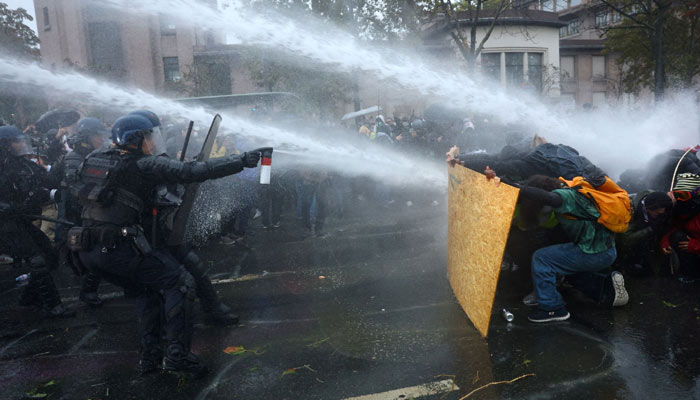
Europe on Edge: Protests Escalate Across Five Countries, Police Deploy Tear Gas and Make Hundreds of Arrests
Europe is facing a fresh wave of public unrest, with demonstrations spreading across France, Albania, Italy, Spain and Portugal over housing costs, rising living expenses, government policies and social grievances. From clashes in Paris and Tirana to the dismantling of protest camps in Madrid and Lisbon, authorities are confronting mounting pressure as thousands take to the streets.
Police have used tear gas and rubber bullets in some locations, while arrests and temporary detentions have followed clashes. Although the protests have different triggers in each country, economic hardship, housing insecurity and dissatisfaction with political decisions remain prominent themes.
FRANCE: NEARLY 1,000 ARRESTED DURING NATIONWIDE PROTESTS
French authorities reported nearly 1,000 arrests across the country as demonstrations on Saturday were accompanied by clashes in several cities.
Interior Minister Laurent Nunez described the violence as “extremely elevated” and accused groups of black-clad extremists of throwing projectiles and setting off fireworks at police officers in an attempt to provoke confrontations.
The Interior Ministry estimated that around 410,000 people participated in demonstrations nationwide, including 110,000 in Paris. The CGT trade union, one of the organisers, put the total turnout at 800,000, including 250,000 in the capital.
Confrontations were reported in Paris, Lyon, Lille, Marseille, Montpellier, Nantes and Toulouse. In Paris, police said more than 3,000 people were stopped and checked, while 65 arrests were made during the demonstration.
French left-wing leader and presidential candidate Jean-Luc Mélenchon accused the authorities of using force in a way that could damage the public image of the protests.
He alleged that police deployed tear gas and fired into the rear of the procession to generate negative television coverage. In a separate post on X, Mélenchon criticised what he described as media efforts to focus on disorder rather than peaceful demonstrations.
Trump blames immigration for French unrest
US President Donald Trump also weighed in on the situation during a campaign rally in Perry, Georgia, on Saturday. He blamed France’s immigration policies for the unrest and argued that people who dislike the country should not be allowed to enter it.
His comments brought immigration into the debate, although the demonstrations across Europe have been driven by a range of distinct domestic issues.
ALBANIA: ANTI-GOVERNMENT DEMONSTRATIONS TURN VIOLENT
Thousands of demonstrators gathered in Tirana on Saturday for another anti-government protest, with police using tear gas and rubber bullets to disperse crowds. Some protesters reportedly responded by launching fireworks at security forces.
The demonstrations have intensified since mid-October, following a period of repeated confrontations between protesters and police. Authorities said several government buildings had been attacked, dozens of demonstrators detained and more than 300 protesters and police officers injured.
The movement began in May amid opposition to a luxury hotel development linked to the family of US President Donald Trump.
The project has drawn criticism over its environmental impact and its implications for Albania’s coastline. Scientists reportedly warned in July that the development had caused irreparable damage to a previously pristine coastal area.
The latest unrest reflects continuing opposition to the project alongside broader dissatisfaction with the government.
ITALY: THOUSANDS PROTEST AS GOVERNMENT TIGHTENS SECURITY
Italian authorities deployed large numbers of security personnel across the country on Saturday as thousands joined demonstrations following violent clashes the previous weekend.
Police said nine people were arrested, while 371 others, including 110 minors, were briefly detained and taken to police stations in eight cities after confrontations broke out during some rallies.
Prime Minister Giorgia Meloni’s government approved tougher security measures earlier in the week and carried out dozens of searches and arrests before the demonstrations.
Meloni praised law enforcement agencies for protecting public safety while preserving the right to peaceful assembly. She accused some demonstrators of attempting to provoke disorder.
The protests have brought together students, truck drivers and farmers concerned about housing affordability, fuel prices and the wider cost-of-living crisis.
The government has also approved financial assistance for businesses facing higher fuel costs following the war in the Middle East.
SPAIN: MADRID HOUSING CAMP BECOMES SYMBOL OF PUBLIC ANGER
Spain’s housing crisis has fuelled a growing protest movement, with an encampment in Madrid’s Puerta del Sol emerging as a focal point for campaigners demanding affordable accommodation.
The camp, which began on a small scale, has expanded into a settlement housing hundreds of people. It now includes a canteen, a clinic and spaces for meetings.
The movement began on September 26 after police evicted an 87-year-old pensioner from her longtime home following a sharp rent increase imposed by the property owner.
The eviction prompted nationwide demonstrations against rising rents and what protesters consider inadequate tenant protections. Tens of thousands have joined the protests, while similar camps have appeared in other Spanish cities.
Prime Minister Pedro Sánchez’s Socialist government introduced two urgent housing bills aimed at restricting evictions and providing indefinite rental contracts.
However, the minority government failed to secure parliamentary approval for the measures. Sánchez subsequently called an early general election for November 29, placing housing affordability at the centre of the political debate.
PORTUGAL: POLICE DISMANTLE LISBON HOUSING CAMP
Portugal’s housing affordability crisis has become another flashpoint, with home prices more than doubling since 2017 and rents for new leases nearly doubling over the same period. Young people have been particularly affected.
Early Sunday, police dismantled a housing protest camp in Lisbon’s Rossio Square, making several arrests and reporting minor injuries. Authorities had not immediately provided exact figures for those arrested or injured.
Shortly after 2 am, dozens of officers, some accompanied by police dogs, entered the camp after warning demonstrators to remove their tents or risk charges related to disobedience.
The encampment had been established after thousands marched through Lisbon on Saturday, with protesters setting up more than 100 tents. Hundreds later gathered to defend the camp after police had removed a similar encampment at the same location earlier in the week.
Demonstrators are demanding action on soaring rents and living expenses. They are also opposing proposed legislation that would make evictions easier and remove rent caps on new leases.
For many participants, the housing crisis reflects broader economic pressures that are making independent living increasingly difficult, particularly for younger households.
ECONOMIC PRESSURES FUEL UNREST ACROSS EUROPE
The protests across the five countries have emerged from different political circumstances, but rising living costs, housing insecurity and frustration with government decisions feature prominently.
Authorities are attempting to maintain public order amid large demonstrations, while protesters continue to demand policy changes and greater economic security.
The latest developments underline the challenge facing European governments: responding to mounting public grievances while managing clashes, protecting peaceful assembly and addressing the underlying causes of discontent.
Comments are closed.