
Chinese Humanoid Robot Runs 100m in 9.39 Seconds, Surpassing Usain Bolt’s Record

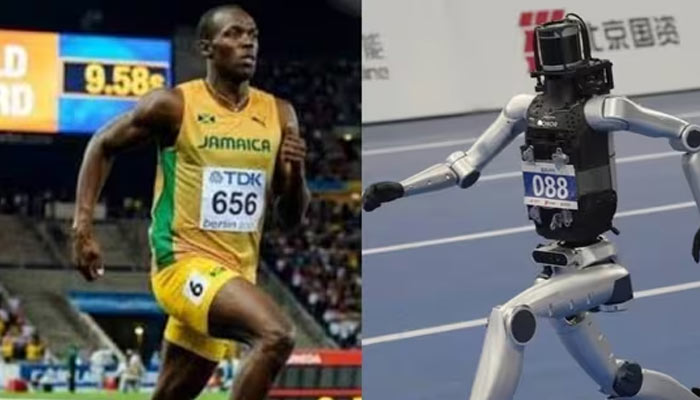
Usain Bolt’s 100-metre world record may have found an unusual challenger — a humanoid robot.
At the World Humanoid Robot Games in Beijing, China’s Tiangong Ultra reportedly clocked 9.39 seconds in a preliminary 100m heat on Saturday, a time faster than Bolt’s 9.58-second world record set in Berlin in 2009.
Bolt had first set the 100m world record at the 2008 Beijing Olympics, running 9.69 seconds before lowering the mark to 9.58 seconds a year later.
TIANGONG ULTRA LEADS ROBOT SPRINT
Tiangong Ultra, created by the Beijing Humanoid Robot Innovation Center, won its heat in 9.39 seconds.
Honor’s humanoid robot Lightning finished second in 9.47 seconds, also beating Bolt’s human world record.
But the two machines’ finishes were far from conventional.
Tiangong Ultra lost its balance after crossing the line and stumbled towards the sidelines, forcing nearby spectators to move away. Lightning also collapsed after its run and reportedly had to be taken away on a stretcher.
The chaotic finishes offered a reminder that robotic sprinting remains very different from human athletics, even as the machines continue to reach remarkable speeds.
A DRAMATIC LEAP IN PERFORMANCE
Tiangong Ultra’s latest time represents a striking improvement from last year’s inaugural competition. The robot won the 100m event then in 21.50 seconds.
It also made headlines by winning the world’s first humanoid robot half-marathon in Beijing.
Lightning had already demonstrated its potential before the games. Chinese state media reported that it recorded 9.32 seconds during a preparatory test, reaching a top speed of 14.5 metres per second.
The robot subsequently won this year’s half-marathon in 50 minutes and 26 seconds. Researchers reportedly increased its leg length by 10 centimetres before the games, taking it from 95 centimetres to 1.05 metres.
51 EVENTS ON THE SCHEDULE
The second edition of the World Humanoid Robot Games features 51 competitions designed to test the machines across a wide range of abilities. Events include track competitions as well as football, dancing and industrial tasks.
Although the robot times cannot be treated as official challenges to Bolt’s human world record, the performances underline the rapid progress being made in humanoid robotics — particularly in speed, balance and movement.
Comments are closed.