

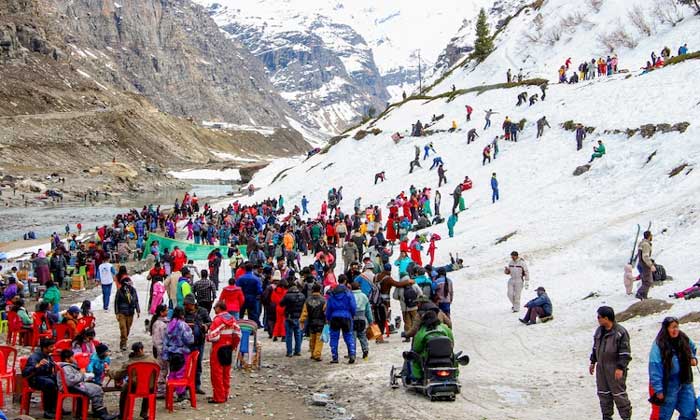
A trip to the snow-covered landscapes of Kashmir is a dream for many travellers. For 26-year-old Neha Reddy, it was supposed to be her first real snowfall experience.
She planned her solo trip at the start of 2024 after researching the best time to visit. “These are places known for skiing,” she said. “Snowfall is almost expected.”
But it never came.
“I completed the trip only because I had already paid for it,” she admitted. “It was really a bummer.”
Reddy’s experience is no longer an exception. Across India, travellers are returning from trips with a similar sense of disappointment — not because of poor planning, but because the climate itself is becoming unpredictable.
A booming industry under pressure
India’s tourism sector is vast and diverse, drawing visitors to Himalayan passes, coastal backwaters, desert forts, wildlife reserves and bustling cities.
According to the World Travel and Tourism Council, travel and tourism contributed roughly 9% to India’s GDP in 2024. Domestic travellers alone spent $185.6 billion that year — a sharp rise from pre-pandemic levels.
But the industry’s biggest strength — its geographical diversity — is also its vulnerability.
“In recent years, climate change has shifted from being a distant concern to a direct disruptor of travel experiences,” said Barun Kumar Thakur, an environmental economics expert at FLAME University.
From mountains to coastlines
The impact is visible across the country.
In the Himalayas, rising temperatures are accelerating glacial retreat and disrupting traditional weather patterns. Data from the India Meteorological Department and the Ministry of Earth Sciences suggests temperatures could rise by up to 4–5°C by the end of the century under high-emissions scenarios.
Mahima Dutta saw this firsthand during a trip to Ladakh in June 2025. Expecting cold weather, she packed heavy winter clothing — but barely needed it.
“We wore jackets only to protect ourselves from the sun,” she said. “It was difficult to even move around during the day.”
Locals told her snowfall no longer lasts as long, altering the region’s once-cool climate.
The story is similar along India’s coasts.
In Goa, rising temperatures are pushing the tourist season earlier and shortening peak travel windows. “Summers are starting as early as mid-March,” said Vikram Puri of Archer Hospitality. “Travellers are adjusting by shifting dates or shortening their stays.”
Regular visitor Rohit Pandey has noticed the difference. “It’s much hotter now,” he said. “Earlier, you could enjoy the weather. Now people stay indoors during the day and step out only at night.”
Cities under heat stress
India’s cities are also becoming harder to navigate for tourists.
Urban centres like Delhi, Mumbai, Jaipur and Bengaluru are witnessing a rise in extreme heat days, worsened by the urban heat island effect — where concrete infrastructure traps heat and raises local temperatures.
“Heatwaves and extreme weather events are directly influencing travel decisions,” said Ravi Gosain of the Indian Association of Tour Operators.
The effects are tangible. Sightseeing is now limited to early mornings and late evenings. Outdoor attractions remain empty during peak hours.
Abhijit Bose, who visited Bengaluru in March last year, recalled the shift. “I had never experienced such heat there in March,” he said, comparing it to his visit in 1995 when the city was known as India’s “air-conditioned city.”
Is the travel calendar breaking down?
For decades, Indian travel followed a predictable rhythm — hill stations in summer, beaches in winter.
That pattern is now breaking.
A report by the Centre for Science and Environment found that India experienced extreme weather on 93% of days in the first nine months of 2024. In 2025, that figure rose to 99%.
When extreme weather becomes constant rather than seasonal, the idea of an “ideal travel window” begins to collapse.
“There is a clear shift,” said Sandeep Arora of Brightsun Travel. “Travellers are moving away from peak summer and choosing shoulder seasons like spring and early autumn.”
A volatile 2026
So far, 2026 has reinforced that trend.
Winter ended unusually early, with warm conditions setting in as early as February. Then came sudden shifts — heavy rain, thunderstorms and even hail in April, followed by sharp temperature spikes.
Such swings — often as high as 6–8°C within days — reflect a growing climate instability.
Instead of gradual seasonal transitions, India is experiencing abrupt and unpredictable changes, raising questions about how both travellers and destinations will adapt.
What lies ahead
If current trends continue, climate disruptions could push up travel and accommodation costs, further reshaping tourism patterns.
India’s holiday landscape remains one of its greatest assets. But it is increasingly under stress.
For travellers, the takeaway is simple but sobering: planning a holiday is no longer just about choosing a destination — it is about understanding climate risks, timing visits carefully, and accepting a degree of uncertainty.
Book the trip, pick the best possible window — and hope the weather cooperates.
Comments are closed.