

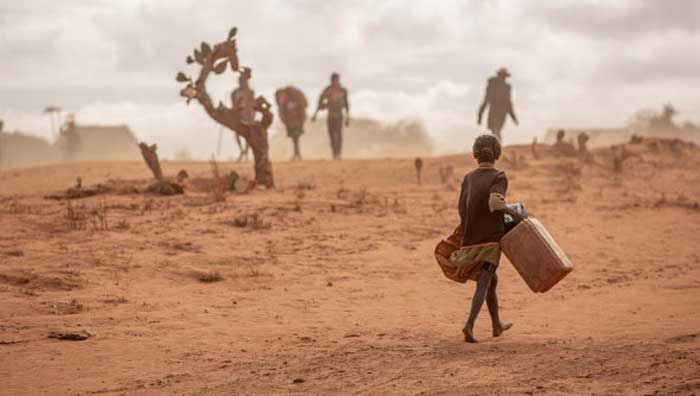
More than 295 million people worldwide faced hunger and starvation in 2025, driven by conflict, displacement, climate shocks, and economic crises.
The troubling reality is that the situation could deteriorate dramatically. My latest research suggests that by 2100, climate change alone may push over a billion people into severe food crises. This estimate includes both those alive today and future generations who may experience at least one episode of acute food insecurity before the end of the century.
As a quantitative ecologist, I use data and computational models to understand how environmental pressures — including climate change, pollution, and land-use shifts — affect ecosystems and human societies.
To explore the future of food insecurity, I developed an artificial intelligence model designed to predict how climate change could trigger severe food crises. The model was calibrated using food insecurity data from the Famine Early Warning Systems Network and integrated historical and projected temperature and precipitation patterns across major global regions. Unlike traditional forecasting methods, which rely heavily on detailed socio-economic inputs that are often unavailable or difficult to project decades ahead, this model focused primarily on climate signals.
The findings are stark. If greenhouse gas emissions remain high, more than 1.1 billion people — including over 600 million children — could be exposed to at least one severe food crisis by 2100.
Africa is projected to shoulder a disproportionate burden. By 2099 alone, over 170 million people may face food crises, including famine conditions. This figure roughly equals the combined population of Italy, France, and Spain today.
However, a different future is possible. If global industries rapidly reduce carbon emissions and societies transition toward sustainable development, exposure to food crises could be cut by more than half. The results underscore a critical point: policy decisions made today will determine whether hundreds of millions face catastrophic hunger or are spared from it.
Predicting Food Crises Through Climate Data
The model drew upon monthly temperature data from the National Oceanic and Atmospheric Administration and precipitation data from the Climate Hazards Center at the University of California. These climate variables were combined with country-level demographic and economic projections to estimate human exposure to food insecurity.
The analysis revealed a deeply concerning trend. The number of people exposed to severe food insecurity nearly tripled within a decade, rising from about 50 million in 2011 to almost 150 million by 2020.
Looking ahead, the cumulative human toll could be immense. More than 1.16 billion individuals may experience at least one famine-related crisis by 2100. Regions expected to suffer the most intense climate impacts — particularly parts of central Africa — are also those with the strongest population growth, suggesting that younger generations will bear the heaviest burden.
The projections indicate that over 600 million children may encounter their first food crisis before the age of five, while more than 200 million newborns could be at risk within their first year of life.
Yet mitigation efforts could dramatically alter this trajectory. The model estimates that nearly 780 million people could be spared from severe food crises if the world embraces sustainable development rather than drifting toward greater inequality and instability.
In fact, under aggressive decarbonisation scenarios, the annual number of people experiencing food crises could fall by more than half by the end of the century.
Africa’s Future Risks and Opportunities
The model projects that most future crises will cluster in regions already vulnerable today, particularly across Africa and Asia. In Africa, food insecurity risks are expected to spread across larger areas, with major hotspots emerging in the Horn of Africa and parts of the Sahel.
Despite these challenges, Africa also presents a significant opportunity for progress. The research indicates that reducing conflict and accelerating sustainable development could sharply lower exposure to food crises after 2050 — potentially more so than in other regions.
The Path Forward
Climate change intensifies food security risks, but political and economic choices determine whether those risks escalate into humanitarian disasters.
Food security is not simply about producing more food. Resilient systems, equitable distribution, climate adaptation, and inclusive agricultural practices are equally essential.
The projections make one message unmistakably clear: decisive global action today can prevent immense human suffering tomorrow. Failure to act, by contrast, risks catastrophic consequences for future generations.
Comments are closed.