
Climate Crisis Strips Zavodovski Island of World’s Largest Penguin Colony Title

A CLIMATE-DRIVEN COLLAPSE
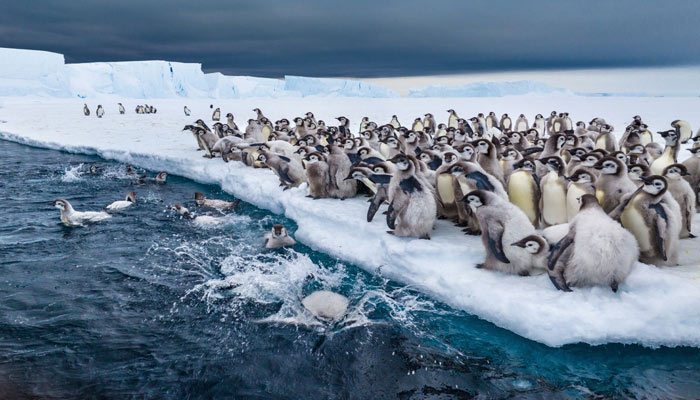
For years, Zavodovski Island, a remote volcanic outpost in the South Atlantic near Antarctica, was known for hosting the world’s largest colony of chinstrap penguins. That distinction has now disappeared.
A new study by researchers from the British Antarctic Survey has found that more than 680,000 chinstrap penguins vanished from the island between 2011 and 2025, wiping out roughly 63% of the colony.
The scale and speed of the decline have alarmed scientists. The number of breeding chinstrap penguins fell from about 1.09 million in January 2011 to only around 402,000 in 2025.
“That’s a very rapid loss,” said Norman Ratcliffe, one of the researchers involved in the study published in Current Biology.
The findings could also have implications for the conservation status of the species. Researchers believe chinstrap penguins may need to be reconsidered for a move from the International Union for Conservation of Nature’s “least concern” category to a more threatened classification.
THE VOLCANO WASN’T TO BLAME
Zavodovski Island is home to Mount Curry, an active volcano that erupted in 2016. Its eruption initially appeared to offer a possible explanation for the dramatic fall in penguin numbers.
But researchers found that the timeline did not fit.
The population decline had already begun before the eruption and continued afterwards at a relatively steady rate. Much of the volcanic ash was also carried northeast, away from the areas occupied by the penguins.
That made the volcano an unlikely explanation for a collapse that had been unfolding for years.
Instead, scientists point towards a much larger force: climate change.
THE KRILL CONNECTION
The South Sandwich Islands, where Zavodovski is located, are home to around 38% of the world’s chinstrap penguins. The species depends heavily on Antarctic krill, making changes in the marine food chain particularly important.
As ocean temperatures rise, krill populations and their distribution are changing. Warmer conditions are pushing some krill populations farther south towards colder waters.
That shift can create serious problems for chinstrap penguins, which are adapted to feeding in the waters around their traditional breeding grounds.
Researchers say the evidence increasingly points towards a climate-driven change in the food web rather than a local event on the island itself.
The study estimates that the chinstrap population at Zavodovski has been shrinking by roughly 7% every year.
ONE PENGUIN DECLINES AS ANOTHER EXPANDS
The most striking part of the study is that not every penguin species on Zavodovski has suffered the same fate.
While chinstrap numbers collapsed, macaroni penguins increased.
Their population rose from about 338,000 in 2011 to approximately 433,000 in 2025. Macaroni penguins have a broader diet, allowing them to exploit a wider range of food sources as environmental conditions change.
Together, the two species now number more than 835,000 on the island — but the balance between them has shifted dramatically.
Scientists describe the change as one of the most dramatic transformations in penguin community composition ever recorded at a single Antarctic location.
A NEW KING OF THE PENGUIN COLONIES
The loss of Zavodovski’s dominance has also changed the global picture.
Cape Adare in Antarctica is now home to the world’s largest known penguin colony. More than one million Adélie penguins were recorded there in 2018.
The transformation at Zavodovski offers a stark illustration of how climate change can reshape entire ecosystems.
For chinstrap penguins, warming seas appear to be disrupting access to the food they depend on. For more adaptable species such as macaroni penguins, the same environmental shift may be creating new opportunities.
Researchers say the most plausible explanation is a climate-induced regime shift — one that is proving increasingly damaging to chinstrap penguins across the maritime Antarctic while benefiting species better suited to warmer, more variable conditions.
Comments are closed.