
Delhi’s air quality sees slight improvement yet remains ‘poor’ as haze persists

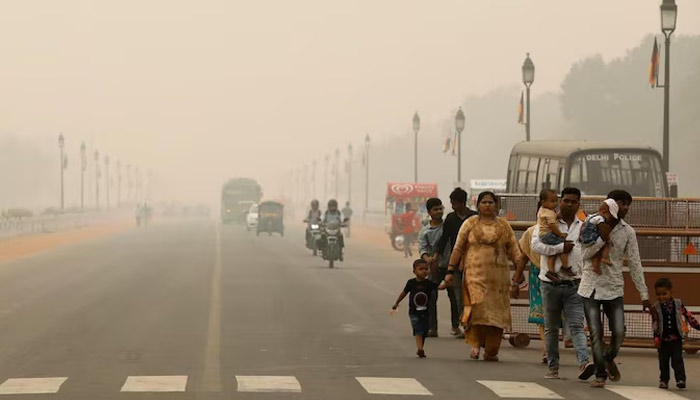
Delhi’s air quality improved slightly on Wednesday, moving from the “very poor” to “poor” category, though a light haze continued to linger over the city.
The Central Pollution Control Board (CPCB) reported an overall Air Quality Index (AQI) of 230, indicating that pollution levels remain a health concern for residents. Areas such as ITO and Akshardham recorded higher pollution levels, with AQI readings reaching 281 in the morning—a small improvement from Tuesday evening’s 291, yet still classified as unhealthy. Earlier this week, the capital experienced three consecutive days of “very poor” air, peaking at 366 on Sunday and 309 on Monday.
Several monitoring stations, including Alipur, Wazirpur, Bawana, and Anand Vihar, had registered “severe” pollution on Tuesday, with readings ranging from 402 to 421. Authorities attributed the poor air quality to cooler temperatures and low wind speeds following Diwali, which trap pollutants near the ground and contribute to persistent smog.
The Commission for Air Quality Management (CAQM) reported a decline in stubble-burning incidents compared to last year. Between September 15 and November 3, Punjab recorded 2,518 farm fires, down from 4,132 in 2024, while Haryana reported 145, a significant drop from 857 the previous year. Over 2,200 fields were inspected, and fines totaling ₹55.75 lakh were imposed on violators.
Meanwhile, a report by the Centre for Research on Energy and Clean Air (CREA) highlighted worsening air quality across India in October 2025. Dharuhera in Haryana was identified as the most polluted city, recording two “severe” and nine “very poor” air days, followed by Rohtak, Ghaziabad, Noida, Ballabgarh, and Delhi.
Delhi ranked sixth nationally, with average PM2.5 concentrations nearly three times higher than in September, showing that while the city has experienced a slight improvement, sustained action is needed to address pollution and ensure cleaner air for residents.
Comments are closed.