
Dhurandhar Review: Power-Packed Performances Elevate Aditya Dhar’s Layered Political Drama

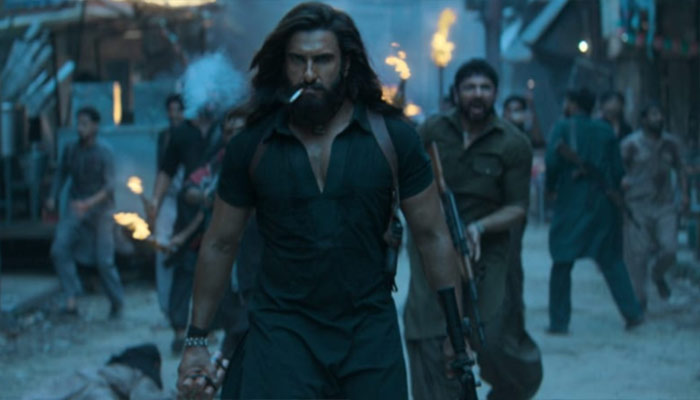
With Uri: The Surgical Strike, Aditya Dhar signalled a new approach to patriotic thrillers. His second film, Dhurandhar, expands that sensibility into a far larger, darker and more politically layered canvas.
Instead of relying on loud sloganeering, Dhar uses moral conflict, grounded violence and stylised music to shape a story that mixes espionage, geopolitics and gangland chaos.
The film is violent, profane and often unsettling, but rarely gratuitous. Its brutality is tied to the world it depicts—an underbelly shaped by power, betrayal and decades of conflict. Told across seven chapters, Dhurandhar is sprawling and intentionally dense, rooted in real historical events but dramatized for cinematic scale.
The story begins in 1999 during the IC-814 hijacking. Intelligence Bureau Chief Ajay Sanyal reluctantly agrees to release terrorists under diplomatic pressure but resolves to hit back. After the 2001 Parliament attack, he formulates Operation Dhurandhar, a covert initiative aimed at dismantling the core of Pakistan’s terror machinery.
Enter Hamza, an Indian operative sent into Lyari—a volatile Karachi neighbourhood run by warring gangs: Rehman Dakait, Babu Dakait and Arshad Pappu. Hamza embeds himself with Rehman, exploiting tensions within the criminal ecosystem while relaying intelligence to India. When Rehman teams up with ISI officer Major Iqbal for a planned attack on India, the operation grows more dangerous.
Following the 26/11 Mumbai attacks, the film shifts gear. Hamza’s internal struggle intensifies as he grapples with the weight of his mission and the cost of maintaining his cover. Major Iqbal, sensing inconsistencies, begins to suspect him. At 3 hours and 30 minutes, Dhurandhar is undeniably long, but Dhar uses the time to build a detailed, lived-in world that rarely feels hollow.
Like Uri, the film is anchored in the idea of a confident, assertive India. Dhar incorporates real footage and audio elements from 26/11, heightening the sense of authenticity. Vikash Nowlakha’s cinematography turns Lyari into a character—gritty, cramped and unrelenting. Shashwat Sachdev’s music, blending retro hits, rap, chants and modern soundscapes, energises several major sequences and adds stylistic flair.
Some standout scenes include a chase set to a hip-hop–infused “Piya Tu Ab To Aaja,” and Sanjay Dutt’s swagger-filled introduction set to “Hawa Hawa.” Even at its most brutal—with heads crushed or bodies thrown into boiling cauldrons—the film occasionally uses dry humour rooted in character rather than punchlines.
Performances elevate the material considerably. Ranveer Singh delivers a restrained turn as Hamza, portraying a man torn between duty and the emotional toll of surviving behind enemy lines. One of his strongest scenes comes when he is forced to participate in celebrations of the 26/11 attacks, his inner turmoil barely contained.
Akshaye Khanna is riveting as Rehman Dakait—controlled, calculating and consistently magnetic. Arjun Rampal’s Major Iqbal is one of the film’s most compelling antagonists: smooth, menacing and unpredictable. Sanjay Dutt’s Aslam blends menace and wry humour with ease. Sara Arjun brings emotional warmth, while R Madhavan and Rakesh Bedi deliver solid support.
Dhurandhar is a large-scale, bruising political thriller with emotional undercurrents that keep it from becoming a simple revenge narrative. Despite its heavy runtime, it maintains grip through strong performances, atmospheric craft and Dhar’s ambitious storytelling.
The film ends without a cliffhanger, but with a clear sense that a second chapter is coming. What stays with you is not just the scale or the violence, but the weight of the choices its characters carry—and the promise of where Dhar will take them next.
Comments are closed.