

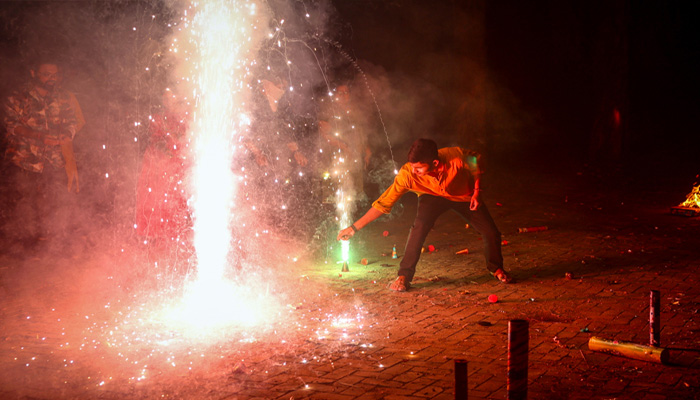
Diwali in Delhi overshadowed by toxic air as pollution soars, red zone curbs enforced.
Delhi woke up to dangerously polluted air on Diwali, with the Air Quality Index (AQI) hitting 335 by 7:30 am on Monday, placing the city in the “very poor” category. Most monitoring stations reported levels above 300, making breathing difficult across the capital.
The spike in pollution follows the Supreme Court’s recent approval for the limited use of green crackers in Delhi-NCR. In response to the deteriorating air quality, the Commission for Air Quality Management (CAQM) implemented Stage II of the Graded Response Action Plan (GRAP) on Sunday, in addition to Stage I measures already in effect since October 14.
According to the Central Pollution Control Board (CPCB), 24 of Delhi’s 38 monitoring stations recorded “very poor” air on Sunday night. Anand Vihar recorded the highest AQI at 417, falling in the “severe” category. Other affected areas included New Delhi (367), Vijay Nagar, Ghaziabad (348), Noida (341), Noida Sector 1 (344), and Gurugram (283).
Several localities reported AQI above 300, including Wazirpur (364), Vivek Vihar (351), Dwarka (335), RK Puram (323), Siri Fort, Dilshad Garden, and Jahangirpuri (318), Punjabi Bagh (313), Nehru Nagar (310), Ashok Vihar (305), and Bawana (304).
The India Meteorological Department (IMD) forecasts that air quality may worsen further into the “severe” category on Tuesday, the day after Diwali. Temperatures are expected to range from 21°C to 33°C.
CAQM has also directed implementing agencies to maintain strict vigilance on dust control and ensure compliance with pollution mitigation measures. The Sub-Committee on GRAP reviewed pollution forecasts from the IMD and the Indian Institute of Tropical Meteorology (IITM), which warned of continued deterioration.
Chief Minister urges environmentally friendly celebrations
Delhi Chief Minister Rekha Gupta extended Diwali greetings while appealing to residents to burst only green crackers, as permitted by the Supreme Court. Firecrackers are allowed from 6–7 am and 8–10 pm, with sales permitted from October 18 to 20.
She encouraged traditional festivities, such as lighting diyas, making rangoli, and sharing sweets. “This Diwali is unprecedented for Delhi. While green crackers are allowed, we also organised a grand ‘Divya Deepotsav’ at Kartavya Path for the first time since independence,” she said on X.
Comments are closed.