

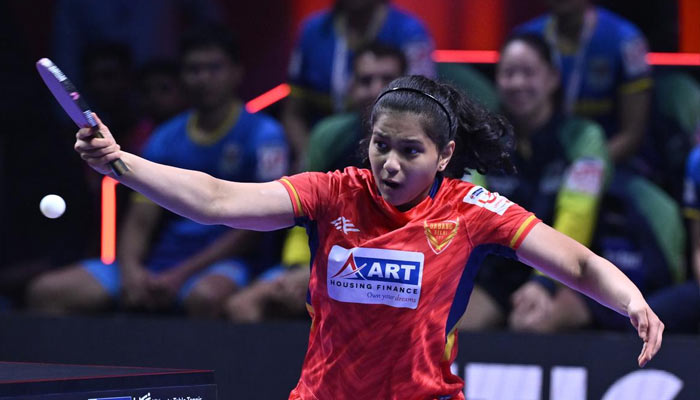
Diya Chitale Isn’t Just Here to Play — She’s Here to Win.
You might miss Diya Chitale in a crowd. At 4’11”, the 22-year-old blends in easily, her movements precise, her demeanor almost monk-like — quiet, efficient, self-contained. But give her a table, a paddle, and a crowd — and she becomes someone else entirely.
On the table, Chitale is electricity. She shrieks. She stares. She doesn’t just play the game — she takes control of it. In a recent UTT match against Kolkata Thunderbolts, Chitale trailed 3–7. Eight straight points later, she’d turned the match around and stunned her opponent Ananya Chande into silence.
Then she turned to the home crowd and thanked them — for cheering against her. “The drums really helped us until the end,” she said, deadpan, in the post-match interview. “Thank you for the drums.”
The Making of a Fighter
That moment wasn’t a fluke. It was years in the making. Diya Chitale is part of a new generation that’s reshaping Indian table tennis — fearless, battle-hardened, and ready to take on the world. Alongside Manush Shah, she’s ranked 11th in the world in mixed doubles. The duo recently bagged the WTT Contender Tunis 2025 title, edging out Japan’s Olympic medal-winning pair in a nail-biting final.
For a sport that’s often fought for relevance in cricket-mad India, Chitale’s rise couldn’t have come at a better time. India’s men’s and women’s teams have qualified for the Olympics for the first time in history. Eight Indian players will go to Paris 2024 — the largest-ever squad.
Chitale doesn’t just want to be part of that squad. She wants to end India’s Olympic medal drought. “I think mixed doubles is where we have the biggest chance. It’s a separate medal event now. And we’ve started beating top-ranked pairs. That gap is closing,” she says.
Obsession in Motion
To watch her play is to see intensity distilled. Her game is fast and fearless, but it’s the mindset that sets her apart. Chitale trains like it’s religion — the kind of obsession that turns talent into transformation. “I’ve always been self-motivated. My parents never had to push me. From the start, I wanted this,” she says.
The influence of Virat Kohli is unmistakable — right down to the ‘Virat’ jacket she wears during our interview. Like Kohli, she thrives under pressure. She doesn’t shy away from emotion. And she doesn’t hide what she’s chasing. “I have learned that you can’t force it. You put in the work, day after day. The rest comes when it’s supposed to,” she says.
Even her downtime — when it exists — is planned. Board games with cousins, the occasional movie or series, sleep. The last film she saw? She draws a blank. Not because it wasn’t memorable — but because her mind is somewhere else.
A Coach Who Dared to Think Big
Chitale’s story took a turn when she met coach Sachin Shetty. Her first taste of table tennis came on family vacations. A bronze medal at a local district event sparked interest. But it was the silver at the U12 Nationals that changed the trajectory — and Shetty’s no-nonsense advice sealed it.
“He told me — if you want to win medals for India, not just wear the jersey, you need to do more. Think beyond,” she recalls. More meant training abroad. Competing non-stop. Rebuilding her game from the ground up.
It worked.
She’s now part of India’s elite TOPS (Target Olympic Podium Scheme) developmental program. She credits it for helping her travel, compete, and keep up with the international calendar — which, in table tennis, never really stops.
From Bleachers to Primetime
In 2017, Chitale was just another fan in the stands of Ultimate Table Tennis — India’s first serious domestic league for the sport. She watched from the crowd, dreaming of a spot on the table. In 2023, she got it. Signed by her hometown team U Mumba, she finally got her shot — and lost every single match.
“It was tough,” she says. “The pressure, the lights, the crowd… it’s a different world. You think you’re ready until you’re not.”
But she didn’t crumble. She adapted.
Two years later, she’s the most expensive Indian player in the league, bought back by Dabang Delhi for ₹14.1 lakh. And this time, she’s delivering.
Learning to Let Go
As our conversation ends, Chitale checks the time. The 45-minute interview has eaten into her rigid schedule, but she doesn’t complain. Her routine is her fortress. She’s learning, though — not just to fight, but to flow. To loosen her grip, just a little, and let the game come to her.
“The more you chase something, the more it slips away,” she says. “So now I just try to show up, do the work, and stay ready. If it comes, it comes. If not, I’ll try again.” That’s the Diya Chitale philosophy: relentless, but not reckless. Obsessive, but self-aware. She’s no longer chasing the light — she’s becoming it.
Comments are closed.