
Elon Musk’s DOGE to ‘No NATO’ for Ukraine: Key takeaways from Donald Trump’s first cabinet meet

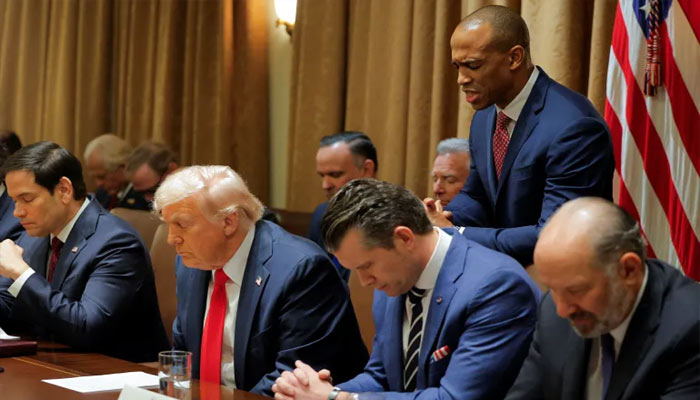
US President Donald Trump held the first Cabinet meeting of his new term, with an unusual guest making an appearance at the table where majorly Senate confirmed officials are chaired.
That guest is the co-chair of the ‘department of government efficiency’ (DOGE) and Trump’s close ally, Elon Musk. Clad in a t-shirt that said ‘tech support’ and a campaign hat of ‘Make America Great Again’, Musk stood next to the president.
From talking about his role in the federal government to DOGE’s work report email, Musk gave reporters a rundown of what his team has been aiming at. Billionaire and DOGE co-chair Elon Musk was one of the first persons, a star turn so to say, to speak at the cabinet meeting. He described his role as “humble tech support” for the federal government.
He defended his team’s cost-cutting efforts, and said that if they failed then “America would go bankrupt”. Trump seemed to happily give time for a ‘little summary’ of what work Musk’s DOGE has been up to and backed his ally, saying that the Tesla CEO has found evidence of “horrible things” afoot in the government.
The president also mentioned how Musk is “sacrificing a lot”, speaking about the latter being away from his businesses and focusing on his efficiency team. “He’s also getting hit,” he added. While Musk took pride in his team’s work, he also mentioned that his efforts to cut down government spending would also be”mistakes”.
He noted that while slashing down the US Agency for International Development (USAID) funds, the Ebola prevention grant was accidentally cancelled. However, he said that there were no issues in the service before the funding was restored.
“One of the things we accidentally cancelled very briefly was Ebola, Ebola prevention. I think we all want Ebola prevention, so we restored it immediately,” he said.
Mass layoffs, budget cuts
The Trump administration ordered federal agencies to do more large-scale layoffs as Musk’s role as the downsizing czar continued to be in the spotlight. The memo instructed agencies to submit a plan by March 13 for a “significant reduction” in staffing. The new orders show just how serious Trump and Musk are about slashing down the size of the US government.
At his cabinet meeting, Trump said that his environmental protection agency administrator, Lee Zeldin, is planning to cut up to 65 per cent of his more than 15,000 employees. Meanwhile, according to a Reuters report, bureaus like the US Fish and Wildlife Service and the Bureau of Indian Affairs have also been ordered to prepare for workforce cuts which might go as high as 40 per cent.
As the Musk-Trump efforts on the cuts came in, Musk expressed at the cabinet meeting that he could cut the $6.7 trillion budget by $1 trillion this year.
Musk’s DOGE work report mail threat
Elon Musk had last week announced that federal staff were required to respond to an email asking for their past week’s work report, explaining in five points what all they have achieved in the week. The email carried a tight deadline, Monday, non-compliance with which would result in termination, he had said. However, several federal agencies reacted to the threat with massive uproar, advising their employees to not respond to the email.
Eventually, the Trump administration backed away from the deadline. Since then, Musk has renewed the threat. “Subject to the discretion of the President, they (federal staff) will be given another chance. Failure to respond a second time will result in termination,” he posted on social media.
Musk further defended his email to the cabinet, saying that it was an attempt made to find out whether government payments were going to actual alive workers. “We think there are several people on the government payroll who are dead,” he said.
He said that the move was merely a “pulse check” to ensure that those working for the government still have a “pulse and two neurons”, adding that if they are real and alive they can “write an email”. Musk described this as “not a high bar” for the employees to meet.
Trump also backed Musk’s work report demand and told reporters, “Those million people that haven’t responded to Elon, they are on the bubble. I wouldn’t say that we’re thrilled about it.”
Trump’s excitement over gold card
Donald Trump told his cabinet that the new revenue from the sales of the “gold card” visa would be used to pay off America’s debt. His new programme seeks to replace a 35-year-old visa program for investors.
“I happen to think it’ll sell like crazy. It’s a market. But we’ll know very soon,” Trump said. He said that if one million “gold card” visa is sold, then that results in the administration’s “$5 trillion” revenue. Trump said that he thinks there’s “really a third” among the business community to participate in this new visa card initiative.
Commerce Secretary Howard Lutnick also told reporters that the gold card visa would replace the EB-5 programme, which offers US visas to investors who have spent about $1 million on a company with at least 10 employees. He said that though the programme has been around for many years, “it was poorly overseen, poorly executed”.
Trump also clarified that the “gold cards” would not need congressional approval. He further said that the possible future recipients of this “will be wealthy and they’ll be successful and spending a lot of money and paying a lot of taxes and employing a lot of people, and we think it’s going to be extremely successful”.
Tariffs on Canada, Mexico from April
Donald Trump on Wednesday sowed new seeds of confusion as he said that the 25 per cent tariffs on Canada and Mexico will be implemented on April 2.
A decision that the US President made right after taking charge of the office was pushed forward to March 4 after he received concessions from both countries, who are also the leading trade partners of America. His decision to put a month-long delay also came with the agreement from both nations to further tighten their border control measures.
Speaking to reporters, Trump clarified that he was not stopping the tariffs.
Additionally, commerce secretary Lutnick also said that Canada and Mexico could face reciprocal tariffs in April, which is a separate plan from that of the president. He said the difference is that the levies are aimed at curbing the flow of fentanyl in comparison to the reciprocal tariffs that Trump called for.