
EU–India near conclusion of landmark trade pact worth a quarter of global GDP

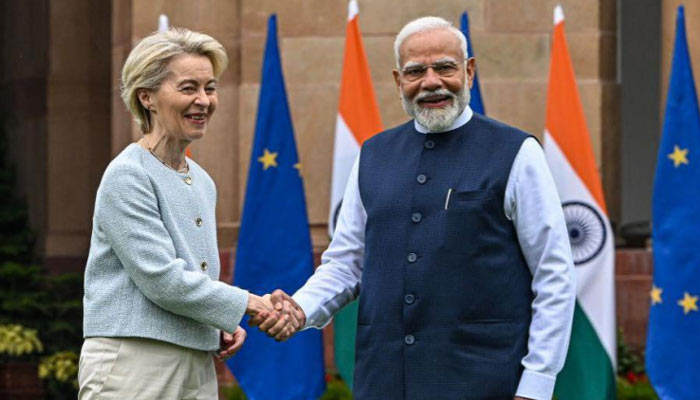
The European Union is edging closer to a long-awaited free trade agreement with India, European Commission President Ursula von der Leyen indicated.
At the World Economic Forum in Davos on Tuesday, signalling what could become one of the most consequential trade breakthroughs for both economies in years.
“There is still work to do. But we are on the cusp of a historic trade agreement—what some call the mother of all deals—one that would create a market of 2 billion people, accounting for almost a quarter of global GDP,” von der Leyen said, highlighting the EU’s push to diversify and de-risk its trade partnerships.
Why the deal matters
The scale of the proposed pact is vast. By linking one of the world’s fastest-growing major economies with a bloc that remains a cornerstone of global trade, the agreement would significantly reshape supply-chain flows at a time when governments are reassessing economic dependencies.
For the EU, India is central to efforts to reduce reliance on China while expanding ties with trusted partners. For India, deeper access to the 27-nation bloc—its second-largest trading partner—would boost export competitiveness and support ambitions to move up the manufacturing value chain.
Long road, renewed momentum
Negotiations on the India–EU free trade agreement began in 2007 but stalled for nearly a decade before being revived in 2022 amid renewed political commitment on both sides. Since then, talks have progressed alongside the India–EU Trade and Technology Council, a parallel platform aimed at cooperation on critical technologies, digital governance and supply-chain resilience.
This twin-track approach has helped narrow differences on sensitive regulatory issues and modernised discussions beyond traditional tariff negotiations.
What is driving the final push
Geopolitical shifts have added urgency to the talks. Brussels is accelerating its diversification away from single-country dependencies, while India is positioning itself as a key hub in reconfigured global supply chains.
Bilateral trade has already reached record levels. Goods trade touched €124 billion in 2023, while services trade—driven largely by digital and IT services—is estimated at around €60 billion. Negotiators believe a comprehensive agreement could unlock significantly greater potential, particularly in clean energy, pharmaceuticals, advanced manufacturing and digital services.
Remaining sticking points
Despite the optimism expressed in Davos, major challenges remain. The EU continues to seek deeper tariff cuts on automobiles, wines and spirits—sectors India has traditionally protected to shield domestic producers.
India, for its part, is pressing for more favourable terms for the movement of skilled professionals, a politically sensitive issue within the EU, where visa and mobility rules differ across member states. Sustainability standards, access to public procurement and regulatory harmonisation also remain unresolved.
Von der Leyen’s visit to India early next week is expected to be pivotal. Diplomats see the trip as an opportunity to address the most contentious issues at the political level, providing negotiators with the momentum needed to finalise the text. The visit comes ahead of a planned India–EU leaders’ meeting later this month, where both sides hope to showcase substantial progress—if not announce a breakthrough.
What a final deal could mean
A successful agreement would rank among the EU’s most significant trade achievements in recent years and could sharply deepen India’s integration into global supply chains.
It would expand flows of goods, services and investment, provide more predictable market access, strengthen cooperation on technology and standards, and signal strategic alignment at a time when the global trade order is being reshaped.
With a combined market accounting for nearly a quarter of global GDP, the pact would instantly emerge as one of the world’s most influential trade frameworks.
Comments are closed.