

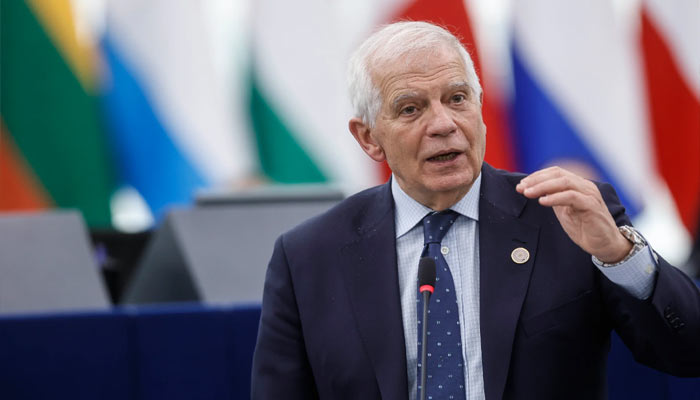
Former EU Diplomat Calls for Stronger European Stance on Israel Over Gaza Crisis.
The European Union must adopt a firmer, more independent approach toward Israel in response to its actions in Gaza, former EU foreign policy chief Josep Borrell has said. In a co-authored article published in Foreign Affairs, Borrell emphasized that Europe has a moral and political obligation to respond to what he described as Israel’s violations of international law.
Borrell, writing alongside Kalypso Nicolaidis—a Franco-Greek academic and former EU advisor—argued that the EU can no longer rely on the United States to lead efforts toward ending the war in Gaza and must instead put forward its own diplomatic initiative.
“Europe can no longer afford to linger at the margin. The EU needs a concerted plan,” they wrote. “Not only is Europe’s own security at stake, but European history imposes a duty to intervene.” The article criticizes the EU’s fragmented response to the Gaza war, warning that internal divisions and a reluctance among some member states to challenge Israel have diminished the bloc’s global influence.
“Europeans cannot stay the hapless fools in this tragic story, dishing out cash with their eyes closed,” the authors said, referring to EU financial support provided without accountability.
Growing Internal Pressure Within the EU
Borrell’s comments come amid increasing scrutiny of Israel’s conduct in Gaza, including recent statements from his successor, Kaja Kallas. Kallas acknowledged last week that Israel had “very clearly” breached its human rights obligations. However, she noted that reaching consensus among EU member states on a response remains a challenge.
Seventeen EU countries recently triggered a formal review of the bloc’s association agreement with Israel in protest over its blockade of humanitarian aid to Gaza. The agreement governs trade, economic, and political cooperation. Last month, Borrell went further, accusing Israel of carrying out “the largest ethnic-cleansing operation since the end of the Second World War.”
Structural Barriers and Possible Paths Forward
Borrell and Nicolaidis pointed to historical sensitivities—particularly in Germany, Austria, and Hungary—as key obstacles to a unified EU response. However, they also laid out mechanisms that allow groups of member states to act independently of full EU consensus.
One such mechanism is Article 20 of the Treaty on European Union, which allows a minimum of nine member states to initiate joint foreign policy actions not tied to defense. “Because such an action has never been taken before, those states would have to explore what it would concretely allow them to do,” they noted.
The article also urged EU members to leverage financial tools and cooperation programs—such as the Erasmus student exchange—as potential pressure points.
EU Marginalized in Diplomatic Arena
The authors criticized the EU’s diminished role in ceasefire negotiations, arguing that internal disunity has sidelined Europe in favor of U.S. and regional mediators like Egypt and Qatar. “The EU continues to be Israel’s largest trading partner, yet it has failed to use that leverage effectively,” the article stated. “Some leaders cautiously supported the International Criminal Court, while others refused to act on its arrest warrants for Israeli officials.”
In conclusion, Borrell and Nicolaidis stressed that unless Europe overcomes its internal divisions and asserts itself diplomatically, it risks further erosion of its influence in global affairs.
Comments are closed.