

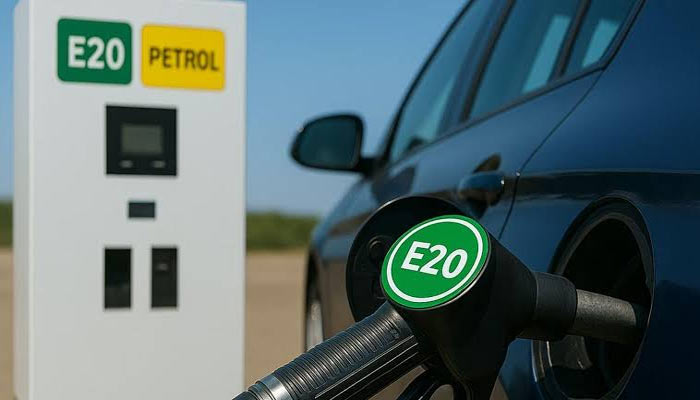
Auto Experts Back Govt’s E20 Push, Dismiss Engine Damage Claims Amid Fuel Debate
A panel of leading automobile and energy experts on Saturday defended the government’s E20 ethanol blending programme, rejecting claims that the fuel harms vehicles and asserting that extensive scientific testing found no evidence of engine-related concerns.
Addressing a press conference amid growing public criticism of the E20 petrol mandate, the experts said the transition followed years of technical evaluation, regulatory approvals and industry-wide testing. They also pointed out that ethanol is widely used in motorsport, including Formula 1 racing, to underline its viability as a fuel.
The panel comprised former Engineers India Limited (EIL) CMD Vartika Shukla, Bajaj Auto Circle Head Manpreet Singh, TVS Motor Senior Vice President (Corporate Affairs) Prashad Krishnan, Toyota Kirloskar Motor Country Head and Executive Vice President (Corporate Affairs and Governance) Vikram Gulati, Maruti Suzuki Senior Executive Officer Rahul Bharti, Hyundai Motor India representative Puneet Anand and Hero MotoCorp representative Ashutosh Verma.
Extensive testing before E20 rollout
Vartika Shukla said India’s ethanol blending programme was the result of years of preparation, noting that the country achieved its E20 target in December 2025. She said the automobile industry carried out extensive testing before the rollout and stressed that the initiative is aimed at reducing carbon emissions.
Shukla added that several countries, including Canada and Paraguay, already use E20 fuel and that the blend complies with Bharat Stage VI (BS VI) emission standards.
‘Very good fuel’: Toyota executive cites Formula 1
Toyota Kirloskar Motor executive Vikram Gulati said vehicle manufacturers follow a rigorous regulatory framework, with fuel specifications clearly defined and vehicles undergoing thorough testing before reaching consumers.
Describing ethanol as “a very good fuel”, Gulati noted that some of the earliest automobiles ran on ethanol and said Formula 1 racing cars also use ethanol-based fuel. He said ethanol helps lower carbon emissions and argued that recent geopolitical tensions in West Asia highlighted the need to reduce dependence on imported crude oil.
‘No evidence of concern with E20’: Maruti Suzuki
Maruti Suzuki Senior Executive Officer Rahul Bharti acknowledged that concerns have largely centred on vehicles manufactured before the E20 mandate came into effect in 2023.
“That is the central question which needs to be addressed,” he said, while adding that the company had not found anything concerning during its evaluation of E20 fuel.
Former IOCL chief backs programme
Former Indian Oil Corporation (IOCL) Chairman B Ashok also defended the programme, saying ethanol blending has strengthened India’s energy security, reduced dependence on imported crude and increased farmers’ incomes.
Speaking to ANI, Ashok said scientific studies have found no evidence that E20 fuel damages vehicle engines or significantly affects mileage, describing many claims circulating online as misconceptions rather than evidence-based concerns.
Government rebuts social media claims
The experts’ remarks came shortly after the Ministry of Petroleum and Natural Gas issued a detailed 10-point rebuttal to what it called misinformation surrounding the E20 programme.
The ministry dismissed claims that producing one litre of ethanol consumes 10,000 litres of water, saying ethanol distilleries typically use around 3-5 litres of processed water per litre of ethanol and increasingly rely on Zero Liquid Discharge systems to recycle water.
It also rejected allegations that E20 causes engine damage, invalidates insurance or harms the environment, maintaining that the programme is supported by scientific studies, international experience and regulatory safeguards.
Launched in 2003, India’s Ethanol Blending Programme aims to reduce crude oil imports, improve energy security and lower emissions. The initiative was implemented in phases through stakeholder consultations and technical preparedness before the rollout of 20% ethanol blending from 2023 onwards.
Debate continues, Bhutan opts to retain conventional petrol
Despite the government’s assurances, the E20 mandate has sparked widespread debate, particularly among owners of petrol vehicles manufactured before 2023, with many claiming reduced fuel efficiency, higher maintenance costs and increased wear and tear.
The discussion has also extended beyond India. According to The Bhutanese, Bhutan has declined an offer from Indian Oil Marketing Companies (OMCs) to switch to E20 fuel, requesting continued supplies of conventional petrol instead. The report said the decision was driven by concerns over Bhutan’s ageing underground fuel storage infrastructure, which could increase the risk of water contamination, rather than any doubts about E20 fuel itself.
Comments are closed.