
From Superstar to Chief Minister: Thalapathy Vijay Begins New Political Chapter in Tamil Nadu

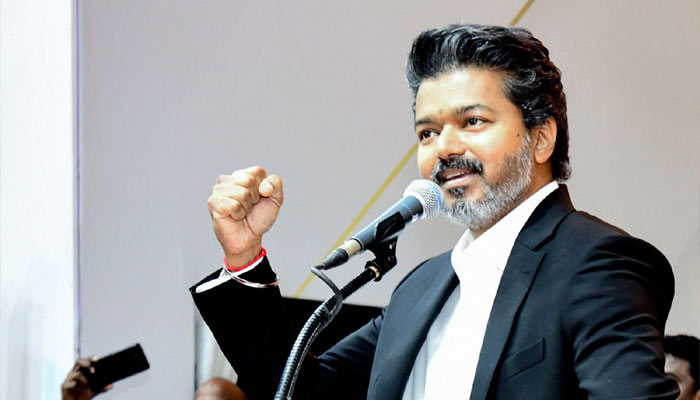
When Thalapathy Vijay walked onto the stage at Chennai’s Jawaharlal Nehru Indoor Stadium on Sunday morning, Tamil Nadu immediately saw something it was not used to seeing from a newly sworn-in Chief Minister.
No white veshti. No carefully rehearsed imitation of traditional Dravidian imagery. Instead, Vijay appeared in black trousers, a crisp white shirt and a blazer — a deliberate visual break from the political culture that has dominated the state for decades.
Even before speaking, the new CM appeared to make his first political statement: this administration did not want to look like old Tamil Nadu politics.
And everything that followed reinforced that message.
Unlike conventional swearing-in ceremonies where leaders quietly finish the constitutional formalities and leave, Vijay turned the event into a carefully staged public performance. He remained on stage, directly addressed the crowd and then signed official government files in front of television cameras.
The optics were impossible to miss.
It was governance designed for the social media era — visual, dramatic and instantly shareable. Every moment looked tailored for television highlights, Instagram reels and WhatsApp forwards.
But behind the spectacle was a clear political calculation.
“There are no parallel power centres in TVK. I am the only head,” Vijay declared during his speech, delivering perhaps the strongest political line of the afternoon.
The message was aimed internally as much as externally. Tamil Nadu politics has historically been shaped by factionalism, competing advisors and succession wars. Vijay appeared eager to establish unquestioned authority from the very beginning.
At the same time, he balanced that hard-edged assertion with emotional messaging that has long defined both his film career and public image.
He repeatedly stressed inclusivity, saying the government belonged equally to Hindus, Muslims and Christians. Then came the line that triggered one of the loudest reactions inside the stadium: “Whether you are my friends or enemies, all 8 crore people are my people.”
It was classic Vijay — emotional, cinematic and broad enough to resonate across political divisions.
He also attempted to frame his rise as a journey built through struggle. Vijay spoke openly about criticism, humiliation and resistance faced during his political entry, presenting himself as someone who succeeded despite repeated attacks.
But symbolism alone was never going to satisfy expectations surrounding a first-time Chief Minister.
That is why Vijay moved quickly to project decisiveness.
On stage itself, he signed orders related to 200 units of free electricity, a dedicated anti-drug task force and a women’s protection force. The choreography felt intentional: emotional appeal first, executive action immediately after.
The focus on women’s safety and anti-drug campaigns also revealed the government’s early political priorities. Both issues strongly connect with urban middle-class families and younger voters — two groups that played a major role in TVK’s rise.
Vijay is also expected to directly monitor policing and internal security during the opening months of his administration, signalling that the government wants tight control during what could become a politically volatile transition phase.
The people surrounding him on Day One revealed another important layer of the new government.
TVK’s ecosystem is not built entirely around traditional politicians. Instead, it combines loyalists, technocrats, digital strategists, former rivals and young professionals.
Among the most influential is N. Anand, better known as Bussy Anand, widely seen as Vijay’s closest organisational lieutenant. Long before TVK formally entered politics, Anand helped transform Vijay’s fan clubs into booth-level political networks.
His prominence reflects an important feature of Vijay’s politics: personal loyalty appears to outweigh ideological history.
Another key figure is Aadhav Arjuna, a former basketball player and political strategist whose rise reflects the increasing professionalisation of Indian election campaigns. With experience across multiple political ecosystems, Arjuna represents TVK’s attempt to combine modern campaign management with mass politics.
Then there is Keerthana, one of the youngest faces in the cabinet. Her rise from political consulting into frontline politics signals TVK’s willingness to reward communication skills, youth and media visibility instead of relying only on seniority.
P. Venkataramanan’s inclusion also generated attention because it marked the return of a Brahmin representative into Tamil Nadu’s cabinet structure after decades — a move interpreted by many as an attempt to broaden TVK’s social coalition beyond traditional Dravidian alignments.
Balancing the youthful faces is veteran leader KA Sengottaiyan, whose decades of administrative experience provide institutional stability inside an otherwise inexperienced political structure.
The intellectual and policy backbone of the party is widely associated with KG Arun Raj, the doctor-turned-former IRS officer who emerged as one of TVK’s key manifesto architects during the campaign.
Then comes perhaps the most modern part of the entire experiment: the digital machinery. Figures like Rajmohan and C. T. R. Nirmal Kumar helped TVK dominate online discourse through memes, decentralised social media networks and rapid-response political narratives. Their influence helped Vijay connect with younger voters in ways older Dravidian parties struggled to replicate.
But the energy and spectacle of Day One will soon face a far tougher test: governance.
Tamil Nadu has embraced actor-politicians before. But every cinematic rise eventually confronts the same question — can charisma successfully become administration?
For Vijay, the immediate challenge will be maintaining political stability. TVK emerged as the largest force, but the government still depends on allies like the Congress, Left parties and VCK. Coalition politics in Tamil Nadu has historically been fragile.
Then comes the administrative challenge itself.
Running a state demands bureaucratic discipline, economic management and institutional coordination — areas where TVK remains relatively inexperienced compared to established forces like the DMK and AIADMK, which spent decades building deep organisational structures.
The opposition, meanwhile, remains powerful.
M. K. Stalin and the Dravida Munnetra Kazhagam may no longer control the government, but their networks remain deeply embedded across Tamil Nadu’s political landscape. Every mistake made by the new administration is likely to face aggressive scrutiny.
The economic situation may prove equally difficult. Tamil Nadu already carries enormous welfare obligations while simultaneously facing pressure to generate jobs and sustain growth. And perhaps the hardest challenge lies with Vijay’s own supporters.
His fanbase expects transformation with cinematic speed — dramatic change, visible reform and instant results. Real governance rarely moves that quickly. Managing the gap between expectation and reality could become crucial to the government’s long-term survival.
Relations with the Centre could also become a flashpoint. Vijay campaigned strongly on issues like NEET, language politics and federal rights, setting up the possibility of repeated friction with the BJP-led Union government.
Then comes the deeper ideological question.
Beyond anti-establishment sentiment and personality-driven politics, what exactly does TVK stand for as a governing force?
Eventually, Vijay will have to define a clearer economic, administrative and political direction for Tamil Nadu.
Still, his first day as Chief Minister revealed something unmistakable.
This was neither traditional Dravidian politics nor conventional cinema populism.
It looked more like a hybrid political experiment — fan-club mobilisation mixed with digital-age branding, emotional populism combined with corporate-style image management, young professionals operating alongside old political veterans.
Even the black trousers and blazer became part of the larger message.
Because in Tamil Nadu, political symbolism has always mattered.
And on Day One, Vijay made it very clear that his government wanted to project itself as the beginning of something entirely different from the past.
Comments are closed.